Sole Trader vs Company in Netherlands – A Quick Comparison
4 Min
January 8, 2026
Author:
Garry
.png)
In the Netherlands, the legal structure is where the difference really starts between a sole trader and a company. A sole trader, also called Eenmanszaak, is not a separate legal entity. The business and the person are legally the same. This means contracts, responsibilities, and legal obligations sit directly with you. There is no legal wall between personal and business side.
A company, usually a Dutch BV, works very differently. A BV is a separate legal entity. The company can sign contracts, own assets, and take liabilities in its own name. You act as a director or shareholder, not as the business itself. We often explain founders this in a very practical way: with a sole trader, you are the business, but with a BV, you own the business.
This legal separation is the base for everything that comes next — liability, tax planning, banking, and even how seriously partners and clients take you. This is why at FirmNL, we always start with structure clarity before discussing costs or taxes.
Personal Liability & Risk Exposure
Personal liability is where many founders make decisions emotionally, not practically. In the Netherlands, a sole trader carries unlimited personal liability. This means if the business faces debt, legal claims, or penalties, your personal assets are also at risk. Bank balance, savings, even personal property can be questioned. We see founders underestimate this risk, especially when business starts small.
With a Dutch BV, the situation is very different. Liability stays mostly limited to the company. Your personal assets are generally protected, unless there is fraud or serious mismanagement. This legal protection is one of the biggest reasons international founders choose a BV, even when revenue is still low. At FirmNL, we often tell clients: risk does not come only from revenue size, it comes from contracts, clients, employees, and mistakes. A BV gives you a safety layer that a sole trader simply does not have.
This is also why banks, partners, and enterprise clients feel more comfortable working with a BV structure. They know the business is properly ring-fenced and professionally set up.
Taxation Differences (Income Tax vs Corporate Tax)
Taxation is where most founders get confused, and honestly, many online articles oversimplify it. In the Netherlands, a sole trader pays personal income tax on business profits. The tax rate increases as profit goes up. In lower ranges it feels manageable, but once income grows, the tax burden becomes heavy very fast. Some deductions are available, but they reduce over time and do not scale well.
A Dutch BV follows a different system. The company pays corporate income tax on its profits. After that, you decide how and when to take money out — salary, dividends, or reinvestment. This gives much more control over tax planning. We often see founders saving tax simply by structuring payouts better, not by doing anything aggressive.
At FirmNL, we usually explain this in one line: a sole trader is taxed on what you earn, while a BV lets you plan when and how you earn. This flexibility becomes very important once profits are stable or when you plan to grow internationally.
Setup Cost, Registration & Ongoing Compliance (Detailed Explanation)
When founders compare sole trader vs company in the Netherlands, they usually focus only on setup cost. But in reality, setup is just the beginning. The real difference shows over time in compliance, control, and how smooth your operations stay.
Sole Trader (Eenmanszaak)
A sole trader is the easiest structure to start. You can register directly with the Chamber of Commerce, and founders can review the Netherlands company registration process to understand the wider registration requirements.. The cost is low, and the process is fast. For many freelancers, consultants, or small service providers, this feels comfortable in the beginning. Accounting is also simpler, and reporting requirements are limited.
However, what we often see is that founders underestimate the long-term side. Even though compliance looks light, you are still personally responsible for bookkeeping, VAT filings, and income tax declarations. There is no separation, so mistakes directly affect you. As income grows, managing taxes and records becomes more stressful, especially if you are not familiar with Dutch systems.
Company (Dutch BV)
A Dutch BV needs proper incorporation. You must go through a notary, set up share capital, and register the company correctly. The initial cost is higher compared to a sole trader. On top of that, a BV requires structured accounting, annual financial statements, and corporate tax filings. This is where many founders hesitate.
But here is what we see in practice. Because a BV is structured from day one, things stay cleaner. Roles are defined. Finances are separated. Compliance becomes a routine instead of a panic task. When handled properly, ongoing compliance does not feel like a burden, it feels like control.
At FirmNL, we guide founders through this step-by-step, so they do not feel lost after incorporation. We set things up in a way where compliance supports growth instead of slowing it down. This is also why many founders who start as sole traders later convert to a BV — but by then, restructuring costs more.
Our Practical View
If you are testing a very small idea, a sole trader can work. But if you are serious about building something stable, hiring people, or working with international clients, the BV structure usually saves time, stress, and cost in the long run. Setup cost should never be the only decision factor. Stability and clarity matter more.
Banking, VAT & Business Credibility
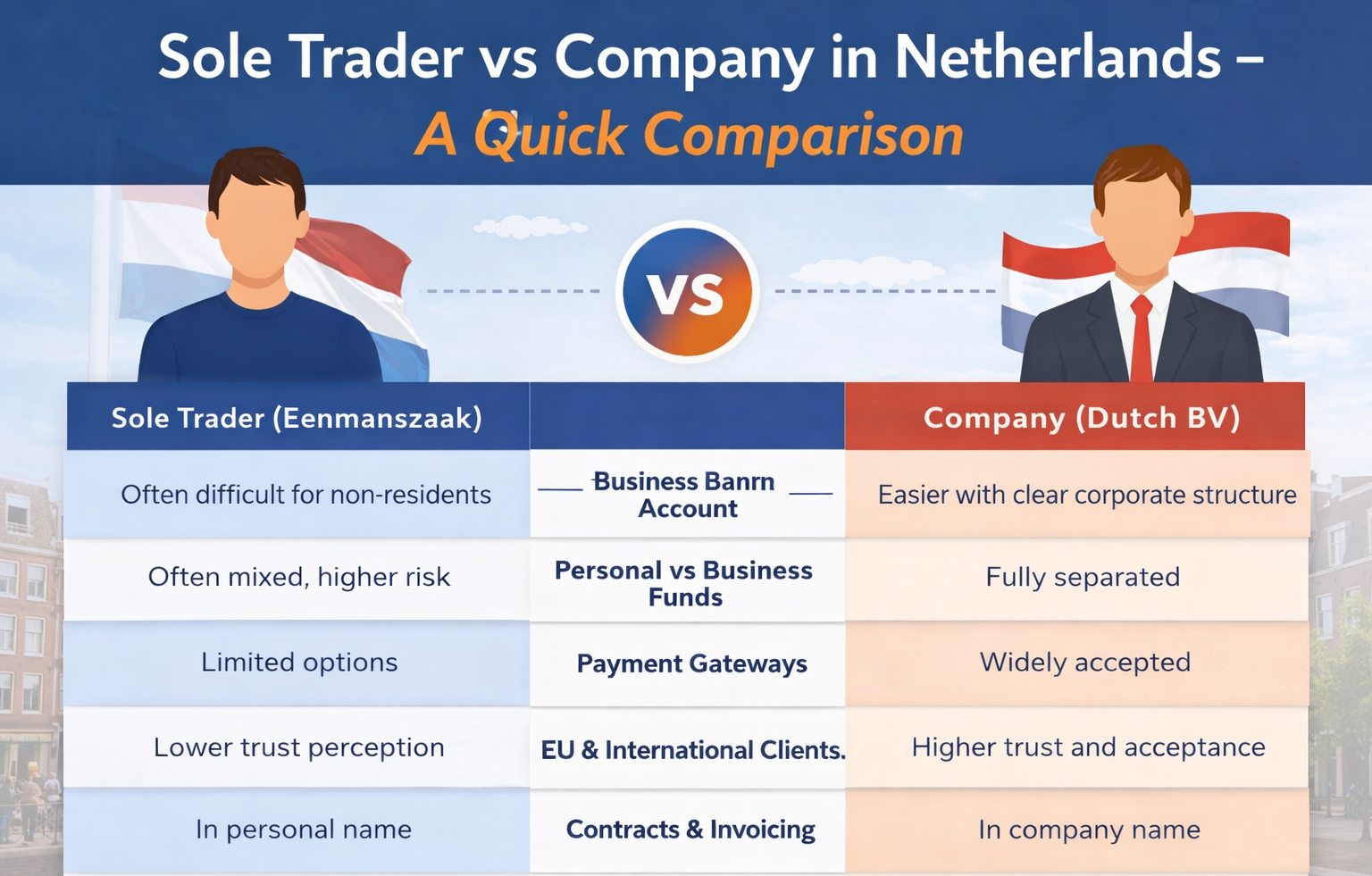
Below is a side-by-side comparison we often use when explaining this to founders entering the Netherlands.
This difference directly affects how banks, clients, and platforms treat your business. For international founders, understanding business bank accounts in the Netherlands is also important because banking requirements can differ depending on the business structure and founder's situation. In many cases, credibility alone pushes founders toward a BV.
VAT Explained: Sole Trader vs Company
VAT rules apply to both structures, but how VAT is handled feels very different in practice.
VAT for Sole Trader
As a sole trader, VAT is tied directly to you as a person. You charge VAT, file VAT returns, and remain personally responsible for any errors or delays. For small local activities, this works fine. But once cross-border transactions start, things become complicated quickly.
We see many foreign founders struggle here. Communication with tax authorities happens at personal level, and mistakes affect personal tax position. Even a small VAT issue can create stress because there is no separation.
VAT for Dutch BV
With a Dutch BV, VAT is clearly linked to the company. The business charges VAT, files returns, and handles correspondence independently from you as an individual. This structure works much better for EU trade, imports, exports, and online services.
Scalability, Investors & Long-Term Growth
Scalability is where the gap between a sole trader and a company becomes very clear in the Netherlands. Many founders start small, but very few plan how the structure will behave once things start working.
Growth as a Sole Trader
A sole trader structure is not built for scale. You cannot issue shares, bring in investors, or easily add partners. Everything depends on you. Even hiring employees or signing long-term contracts increases personal risk. We often see founders hit a ceiling where growth is possible, but structure holds them back.
Banks and investors also hesitate. From their perspective, the business depends entirely on one individual. This makes long-term planning difficult.
Growth as a Dutch BV
A Dutch BV is designed for growth. You can add shareholders, raise investment, and restructure ownership without breaking the business. The company can grow independently of the founder. This is very important for startups, tech companies, and international businesses.
Investors almost always expect a BV-type structure. It gives clarity on ownership, liability, and exit options. Even strategic partners feel more comfortable when they deal with a company, not an individual.
Which One Is Right for You? (Our Practical Recommendation)
Choosing between a sole trader and a company in the Netherlands is not about what is cheapest or fastest. It is about what fits your business reality and future plans.
If you are working alone, serving local clients, and testing a small idea with limited risk, a sole trader can be a practical starting point. It is simple, flexible, and low-cost. But it also comes with personal risk, limited credibility, and almost no room to scale.
If you are planning growth, working with international clients, handling regular VAT, or thinking long-term, a Dutch BV is usually the safer and smarter choice. It protects you personally, improves credibility, and gives you control over tax planning and expansion.
At FirmNL, we do not push one structure for everyone. We first understand your business model, risk level, and growth plans. Then we recommend what actually works, not what looks good on paper. This is exactly how we help international founders build in the Netherlands without unnecessary mistakes.


Ready to Launch
Your

Dutch Business
Dutch
Business
FirmNL specializes in helping foreign entrepreneurs establish a presence across the EU. From Dutch BV incorporation to tax compliance, sales outsourcing and EU fulfillment — we provide solutions tailored to your goals.