How to Register as a Sole Trader in New Zealand
4 Min
January 6, 2026
Author:
Garry

We often see founders searching for “sole trader registration in New Zealand” and assuming it works like company incorporation. In reality, becoming a sole trader in New Zealand is much simpler than most people expect. There is no company-style registration, no Companies Office filing, and no setup fee. What actually matters is notifying Inland Revenue that you are working for yourself and then staying compliant from day one.
This confusion creates problems later. Many people think once they “start working,” everything is done. But compliance does not stop at starting. Taxes, GST thresholds, ACC cover, and record keeping all begin immediately. If these are ignored, penalties can follow even when the business is small. We explain this clearly because we see founders make the same mistake again and again.
In this guide, we explain how registering as a sole trader in New Zealand really works, what is legally required, and what is optional. We keep it practical, simple, and aligned with real government rules. The goal is to help you start correctly, not just quickly, so your business does not face trouble later.
What Is a Sole Trader in New Zealand?
A sole trader in New Zealand is an individual who runs a business or works independently without setting up a company. You and the business are legally the same. There are no directors, no shareholders, and no separate legal entity.
This structure is widely used by:
- Freelancers and consultants
- Contractors and tradespeople
- Online service providers
- Small business owners starting out
As a sole trader:
- You keep 100% of the profits
- You make all decisions yourself
- Business income is taxed as personal income
- Business debts are your personal responsibility
There is no legal separation between you and the work you do. This structure works well when operations are simple and risks are low.
In New Zealand, most people start as sole traders because it allows them to begin trading quickly without legal complexity. You can still hire employees, issue invoices, and work with clients professionally. Many founders later move to a company structure once revenue grows, risk increases, or outside investment becomes relevant.
What You Must Prepare Before Starting as a Sole Trader
Before you start working as a sole trader in New Zealand, a little preparation saves a lot of trouble later. At FirmNL, we see people jump straight into work without setting the basics right, and then struggle with tax or compliance questions after income has already started coming in.
1. IRD Number
You must have an IRD number. Most people already have one from employment or banking. If not, you need to apply before doing anything else. Inland Revenue uses this number to track your income, tax, GST, and ACC obligations.
2. Clear Business Activity Description
You should clearly understand and describe what type of work you are doing. Inland Revenue and ACC use this information to determine:
- Tax treatment
- ACC levy rates
Even simple categories like consulting, construction, design, or online services matter more than most people realise.
3. Compliance Mindset
Starting as a sole trader is easy. Staying compliant is ongoing. From day one, you should be prepared to:
- Track income and expenses
- Keep proper records
- Understand tax, GST, and ACC obligations
This preparation separates smooth setups from stressful fixes later.
Read More: What is the UBO-register?
Step-by-Step: How to Register as a Sole Trader in New Zealand
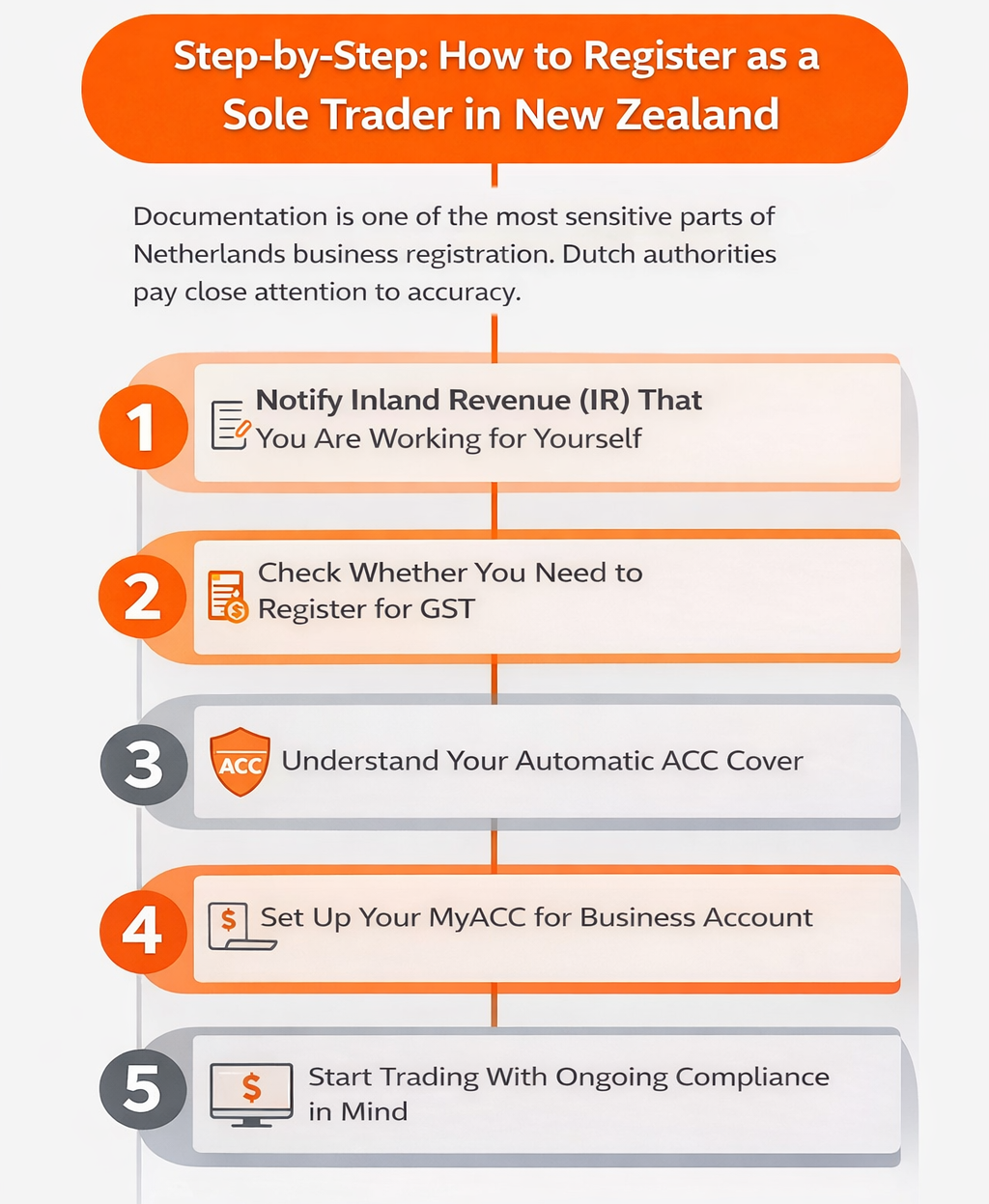
Step 1: Notify Inland Revenue (IR) That You Are Working for Yourself
The first and most important step is informing Inland Revenue (IR) that you have started working as a sole trader. There is no company-style registration involved. This notification is done through your myIR account.
If you already have an IRD number, simply log in and notify IR that you are earning income as a sole trader. If you do not have an IRD number, you must apply for one first and then complete this step. There is no fee for notifying Inland Revenue.
This step officially starts your tax obligations. From this point, Inland Revenue treats your business income as personal income.
Step 2: Check Whether You Need to Register for GST
After notifying Inland Revenue, you need to review your GST position. If you expect your income to exceed NZD 60,000 within any 12-month period, GST registration becomes mandatory. This applies even if the increase in income happens gradually.
If your income stays below this threshold, GST registration is optional. However, many sole traders do not monitor their revenue closely and register late. Late GST registration can lead to penalties and backdated GST payments. Checking this early helps you avoid unnecessary issues later.
Step 3: Understand Your Automatic ACC Cover
Once Inland Revenue is notified, your details are automatically shared with ACC. This activates ACC CoverPlus, which provides personal injury cover if you are unable to work due to an accident.
Although the cover starts automatically, you still need to be aware that ACC levies are payable. These levies are based on the type of work you do and your earnings. Many sole traders assume ACC is fully handled in the background, which is not the case.
Step 4: Set Up Your MyACC for Business Account
To manage your ACC obligations properly, you should create a MyACC for Business account. This allows you to review your details, confirm your work classification, and manage your levy invoices.
If this step is missed, ACC may calculate levies based on assumptions, which can result in incorrect or higher charges. Setting up your MyACC account early gives you better control and avoids surprises when invoices arrive.
Step 5: Start Trading With Ongoing Compliance in Mind
Once these steps are complete, you are officially operating as a sole trader in New Zealand. There is no Companies Office involvement, no business registration fee, and no separate legal entity created.
However, the responsibility does not end here. From this point forward, you must manage income tax, GST (if registered), ACC levies, and proper record keeping. Starting with the right setup ensures your sole trader business remains compliant as it grows.
Also Checkout: How to Research if Potential New Product Would Sell?
Tax, GST, and ACC Obligations You Cannot Ignore
Once you start working as a sole trader in New Zealand, your ongoing obligations begin immediately. This is where many people get caught later, not because the rules are complex, but because they assume things will sort themselves out automatically. They don’t.
As a sole trader, your business income is taxed as personal income. Each year, you must file an IR3 income tax return, showing your total income and allowable business expenses. Tax is paid on your net profit, not on total revenue. From your second year onward, Inland Revenue may require you to pay provisional tax, which means paying income tax in instalments during the year instead of one lump sum at the end.
GST is another major obligation. If your turnover crosses NZD 60,000 in any 12-month period, GST registration becomes mandatory. At that point, you must charge 15% GST on most goods or services and file regular GST returns. Registering late when you should have registered earlier can result in penalties and backdated GST, which we see happen quite often.
Then comes ACC. As a sole trader, you are automatically covered under ACC CoverPlus, but this does not mean there is nothing to manage. ACC levies are calculated based on your type of work and earnings, and you will receive an annual invoice, usually after filing your tax return. You are responsible for paying these levies, and setting up a MyACC for Business account helps you keep everything accurate and up to date.
These three areas—income tax, GST, and ACC—are the core compliance pillars for every sole trader. Ignoring any one of them can turn a simple business setup into a stressful situation later.
Final Thoughts: Start Simple, But Plan Smart
Starting as a sole trader in New Zealand is intentionally simple. There is no company registration, no setup fee, and no long approval process. For many people, this makes it the fastest way to begin working, testing an idea, or earning independently. But simple does not mean careless. From the moment you start earning, tax, GST thresholds, and ACC obligations begin to apply.
At FirmNL, we always advise founders to think beyond just “starting.” The real success of a sole trader setup comes from understanding your obligations early, keeping clean records, and knowing when the structure still works and when it starts holding you back. Many compliance issues we see could have been avoided with a little clarity at the beginning.
A sole trader structure is a good starting point, not always the final destination. If you grow, take on more risk, or plan long-term expansion, reviewing your structure at the right time matters. Starting simple is fine. Planning smart is what keeps your business stable as it moves forward.
Other Related Articles
.png)
.png)
.png)
Ready to Launch
Your
Dutch Business
Dutch
Business
FirmNL specializes in helping foreign entrepreneurs establish a presence across the EU. From Dutch BV incorporation to tax compliance, sales outsourcing and EU fulfillment — we provide solutions tailored to your goals.