Top Import Export Business Opportunities in the Netherlands for Global Entrepreneurs
4 Min
March 11, 2026
Author:
Garry
.png)
For decades, the Netherlands has been one of the most important international trade hubs in Europe. Its strategic location, world-class ports, and strong logistics infrastructure make it a preferred base for companies involved in import and export activities. Many global businesses use the Netherlands as their gateway to the European Union market, which gives access to more than 400 million consumers.
The country is home to the Port of Rotterdam, the largest seaport in Europe, and Amsterdam Airport Schiphol, one of the busiest cargo airports on the continent. Together with advanced road, rail, and inland shipping networks, these facilities allow goods to move quickly across the EU. Because of this infrastructure, many international companies choose the Netherlands as their distribution center for European trade.
Another reason entrepreneurs prefer the Netherlands is its business-friendly environment. The country offers efficient customs procedures, transparent regulations, and strong international trade agreements. Dutch logistics systems are highly digitalized, which makes import and export operations smoother compared to many other European markets.
At FirmNL, we work with international founders who want to enter the European market through the Netherlands. Many of them start import export companies, distribution businesses, or e-commerce logistics operations because the country provides the right environment to scale international trade. However, understanding the opportunities and the regulatory requirements is important before starting.
In this guide, we will explain the most promising import export business opportunities in the Netherlands, the advantages of operating from the Dutch market, and how international entrepreneurs can build a successful trade business in Europe.
Whether you’re exploring a completely new venture or expanding an existing trade operation, the Netherlands offers some of the strongest import export business Netherlands opportunities in Europe today. From food and electronics to renewable energy, international entrepreneurs continue to discover profitable Netherlands import export opportunities across nearly every sector, supported by the country’s ports, digital customs systems, and central EU location.
Why Global Entrepreneurs Choose the Netherlands for Import Export Businesses
The Netherlands has built a strong reputation as one of the most reliable countries in Europe for international trade. Many global entrepreneurs choose the Netherlands because it offers a combination of strategic location, efficient logistics, and a stable business environment. For companies that want to import products into Europe or export goods globally, the Dutch market provides a strong operational base.
For entrepreneurs comparing locations to launch a new venture, the Netherlands consistently ranks among the top choices for import export business Netherlands ventures because it combines infrastructure, favorable trade policy, and market access in one location. This is also why so many founders describe the country as home to some of the best Netherlands international trade business opportunities on the continent.
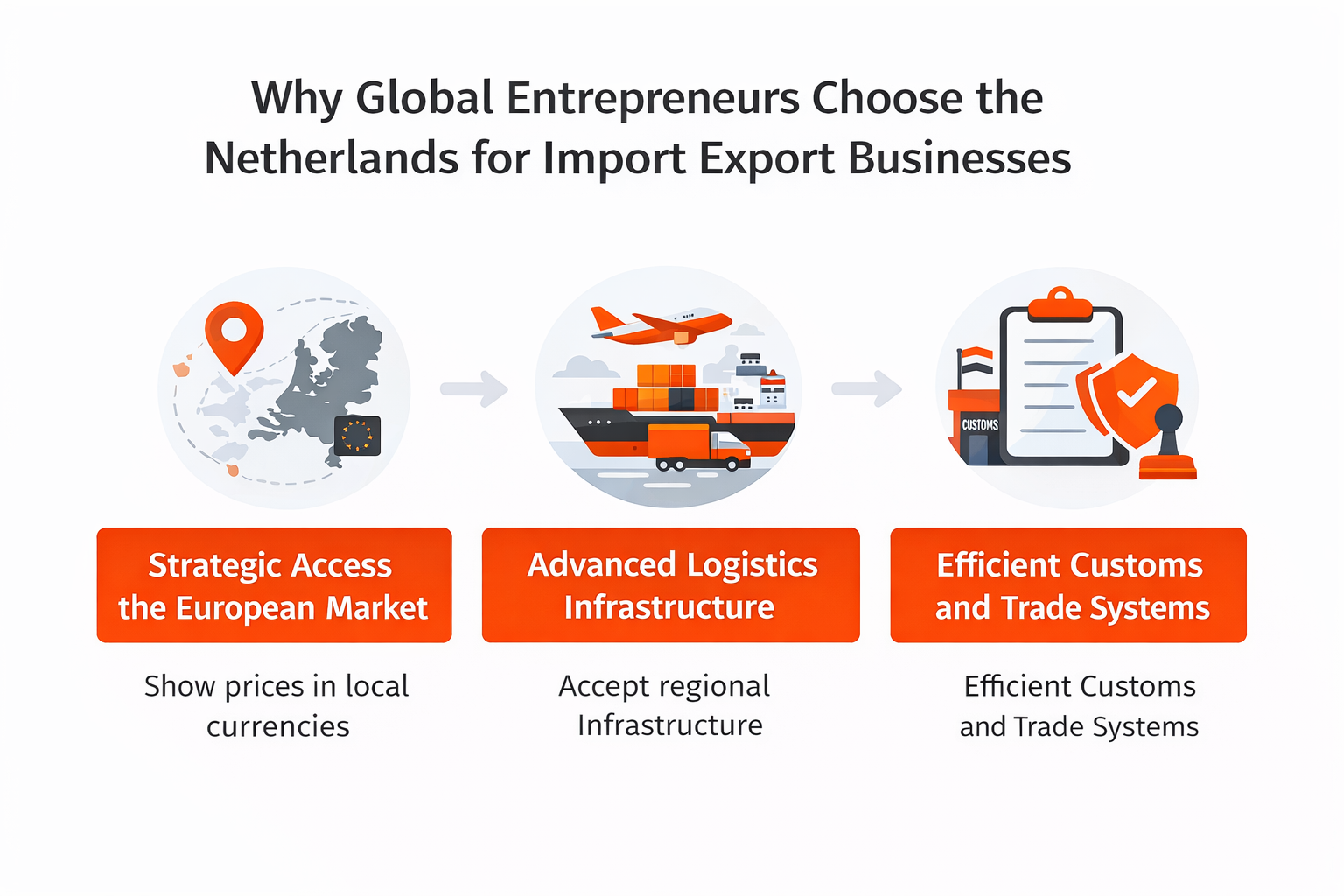
Strategic Access to the European Market
One of the biggest advantages is the country’s location within the European Union. Goods imported into the Netherlands can easily be distributed to major markets such as Germany, France, Belgium, and other EU countries within a short time. Because the Netherlands is part of the EU single market, businesses can trade across member countries without complex border procedures once products enter the EU.
This is precisely why so many advisors describe the Netherlands as the natural home for a Netherlands international trade business seeking EU-wide reach from a single base.
Advanced Logistics Infrastructure
The Netherlands is also known for its advanced logistics infrastructure. The Port of Rotterdam handles millions of containers every year and connects Europe to global shipping routes. At the same time, Schiphol Airport supports high-value and time-sensitive cargo shipments. This makes the Netherlands ideal for companies dealing with electronics, consumer goods, food products, and other internationally traded items.
Efficient Customs and Trade Systems
Another factor that attracts entrepreneurs is the transparent regulatory system and efficient customs procedures. Dutch authorities have invested heavily in digital systems that simplify import and export documentation. This reduces delays and allows businesses to manage supply chains more efficiently.
These factors combined make the Netherlands one of the easiest places in Europe to start import export business in Netherlands operations, whether you are trading agricultural products, electronics, or industrial equipment.
For international founders entering the European market, setting up a Dutch company can also help simplify trade operations. At FirmNL, we often assist entrepreneurs who want to establish a Dutch BV for import export operations, obtain VAT and EORI registrations, and structure their logistics operations in the Netherlands before expanding across the EU.
Key Advantages of Starting an Import Export Business in the Netherlands
Starting an import export business in the Netherlands offers several advantages that make the country one of the most attractive trade hubs in Europe. Because of its infrastructure, trade policies, and strong logistics ecosystem, many global companies use the Netherlands as their European distribution and trade base.
Below are some of the key advantages that make the Netherlands ideal for international trade businesses.

Strategic Location in Europe
The Netherlands sits at the center of the European trade network. From Dutch ports and logistics centers, companies can reach major European markets such as Germany, France, Belgium, and Scandinavia within a short time. This location allows businesses to distribute goods efficiently across the EU.
One of the Largest Ports in the World
The Port of Rotterdam is the largest seaport in Europe and one of the busiest ports globally. Millions of containers pass through Rotterdam every year, making it a major entry point for goods coming into Europe from Asia, the United States, and other global markets.
Advanced Logistics Infrastructure
The Netherlands has one of the most advanced logistics systems in the world. The country has an extensive network of highways, railways, inland waterways, and cargo airports. This infrastructure allows businesses to move goods quickly from ports to warehouses and distribution centers across Europe.
Efficient Customs and Trade Systems
Dutch customs authorities operate highly digital systems that help speed up import and export procedures. Businesses benefit from efficient documentation processing and well-structured trade regulations, which reduces delays and operational complexity.
Strong E-commerce and Distribution Ecosystem
The Netherlands has become a key European fulfillment and distribution center for e-commerce companies. Many global brands store their products in Dutch warehouses and ship them across the EU. This creates strong opportunities for entrepreneurs involved in logistics, distribution, and cross-border trade.
Access to the European Union Market
By operating from the Netherlands, companies gain access to the EU single market, which allows goods to move freely across member states once they enter the European customs zone. This simplifies trade operations for businesses serving multiple European countries.
Because of these advantages, many international entrepreneurs choose to establish their import export operations in the Netherlands before expanding into other European markets. At FirmNL, we frequently support founders who want to structure their Dutch companies specifically for cross-border trade, logistics operations, and EU distribution.
Netherlands Trading Business Opportunities Across Key Sectors
Beyond the advantages already outlined, it helps to look at where the real Netherlands trading business opportunities are concentrated today. The country’s position as a logistics hub means that almost any import export company Netherlands entrepreneurs choose to build can tap into established supply chains, warehousing networks, and distribution partners without starting from zero.
Investors researching business opportunities in Netherlands often find that the trade sector offers faster market entry than manufacturing or services, since companies can begin importing or re-exporting goods almost as soon as their VAT and EORI numbers are approved. This is part of why the import export market Netherlands continues to attract entrepreneurs from Asia, North America, and the Middle East each year.
At the same time, Dutch companies remain active exporters in their own right. Sectors such as agriculture, flowers, machinery, and technology equipment give rise to a steady stream of export business Netherlands activity, much of which flows through Rotterdam and Schiphol before reaching buyers across the EU, UK, and beyond.
Most Profitable Import Export Business Opportunities in the Netherlands
Because the Netherlands acts as a gateway to Europe, several industries have strong potential for import export businesses. Many international entrepreneurs build companies around sectors where the Netherlands already has strong logistics networks and high demand across the EU.
Below are some of the most promising import export opportunities in the Dutch market.
Each of the following sectors represents a proven path for entrepreneurs who want to start import export business in Netherlands operations without competing directly against saturated markets.
Food and Agricultural Products
The Netherlands is one of the largest agricultural exporters in the world. Dutch companies trade large volumes of vegetables, fruits, dairy products, meat, and processed foods across Europe and globally. At the same time, the country imports tropical fruits, spices, coffee, and other food products from Asia, Africa, and South America.
This makes agriculture one of the most established export business Netherlands sectors, with Dutch producers shipping fresh and processed goods to buyers across dozens of countries every week.
This creates strong opportunities for entrepreneurs involved in food import, wholesale distribution, and international agricultural trade.
Electronics and Consumer Goods
Electronics, gadgets, and consumer products are among the most frequently imported goods into the Netherlands. Many international brands import products from manufacturing hubs such as China, South Korea, and Taiwan and distribute them across Europe through Dutch logistics centers.
Entrepreneurs can build businesses around importing consumer electronics, accessories, smart devices, and household goods, then selling them across the EU through distributors or e-commerce platforms.
For entrepreneurs scanning the wider region, electronics remain one of the most consistent import business opportunities Europe has to offer, and the Netherlands is often the first stop before goods move on to Germany, France, or the Nordics.
Sustainable Energy and Green Technology
The Netherlands is investing heavily in renewable energy and sustainability technologies. Equipment such as solar panels, wind energy components, electric vehicle charging infrastructure, and green construction materials are in high demand.
Businesses that import sustainable technologies and distribute them across European markets can benefit from growing demand driven by environmental policies and energy transition initiatives.
This trend is part of a broader shift in import business opportunities Europe is seeing, as more founders prioritize sustainability-linked products over traditional consumer goods.
Logistics and Distribution Services
Because the Netherlands is a major logistics hub, companies that specialize in distribution, warehousing, freight forwarding, and supply chain management often find strong business opportunities here.
Many international companies prefer outsourcing logistics operations to local providers who can manage warehousing, transportation, and EU-wide distribution from the Netherlands.
Because of this, logistics itself has become one of the standout Netherlands trading business opportunities for entrepreneurs who prefer service-based trade models over direct product imports.
Cross-Border E-commerce Trade
Cross-border e-commerce has become one of the fastest-growing trade segments in Europe. Many global sellers import goods into Dutch warehouses and distribute them to customers across the EU through online marketplaces.
Entrepreneurs can build businesses around importing products in bulk and selling through platforms like Amazon, Bol.com, Shopify stores, or direct-to-consumer websites.
This segment alone accounts for a growing share of Netherlands import export opportunities, as more sellers treat the country as their primary EU fulfillment base rather than a secondary market.
Because of the Netherlands’ strong logistics infrastructure and access to European markets, these industries offer significant potential for entrepreneurs who want to build scalable import export operations.
Legal Requirements to Start an Import Export Business in the Netherlands
Starting an import export business in the Netherlands requires meeting several legal and regulatory requirements. These steps ensure that the company can trade internationally, comply with Dutch regulations, and operate within the European Union market. While the process is straightforward, entrepreneurs must complete a few important registrations before starting trade activities.
Entrepreneurs who want to start import export business in Netherlands operations should treat these registrations as a checklist rather than optional extras — skipping any one of them can delay the launch of an otherwise well-planned import export company Netherlands entrepreneurs are eager to get trading.

Register a Company in the Netherlands
The first step is establishing a legal business entity. Most international entrepreneurs choose to set up a Dutch private limited company (BV) because it provides limited liability and is widely accepted for international trade operations. International founders who need assistance with this process can use Dutch BV incorporation services to establish their company and complete the initial registration requirements.
Once the company is incorporated, it must be registered with the Dutch Chamber of Commerce (KVK). This registration officially records the company as an active business entity in the Netherlands.
This step alone often determines how quickly an import export company Netherlands can start trading, since banks and tax authorities require a registered KVK number before issuing VAT or EORI numbers.
Obtain a VAT Number
Businesses that trade goods or services within the Netherlands or across the EU must obtain a Dutch VAT number from the Tax Administration. This number allows companies to charge VAT on transactions and participate in intra-EU trade.
For companies involved in cross-border trade, VAT registration is an essential step because it enables proper tax reporting and compliance with EU tax regulations.
Apply for an EORI Number
Companies involved in importing or exporting goods outside the European Union must also obtain an EORI number (Economic Operators Registration and Identification number). Businesses can complete VAT and EORI registration to obtain the required identification for customs and international shipments.
Without an EORI number, businesses cannot complete customs declarations for importing or exporting goods.
Customs Compliance and Documentation
Import export companies must follow EU customs regulations, which include proper documentation for shipments, product classification, and customs declarations. Depending on the type of products traded, businesses may also need additional permits or certifications.
For example, industries such as food, pharmaceuticals, chemicals, and electronics may require specific compliance approvals before products can enter the European market.
Open a Business Bank Account
A Dutch business bank account is usually required to manage company transactions, pay suppliers, and receive payments from international clients. This account is also important for tax compliance and financial reporting.
For international founders, setting up these requirements can sometimes be challenging because it involves dealing with multiple authorities and administrative procedures. At FirmNL, we assist entrepreneurs with company formation, VAT registration, EORI applications, and compliance setup, making it easier to establish a fully operational import export business in the Netherlands.
VAT, EORI, and Customs Requirements for Import Export Companies
When running an import export business in the Netherlands, understanding VAT, customs procedures, and EORI registration is essential. These elements are the backbone of international trade compliance within the European Union.
Dutch VAT for Import Export Businesses
Businesses trading goods in the Netherlands must operate under the Dutch VAT system. If your company sells products within the Netherlands or across the EU, you must charge VAT and report it through periodic VAT returns.
For cross-border trade within the EU, businesses can usually apply the intra-community supply rules, which allow VAT-free transactions between EU-registered businesses when certain conditions are met.
Import VAT on Goods Entering the EU
When goods enter the Netherlands from outside the European Union, import VAT normally becomes payable at the time of customs clearance. This can create cash flow challenges for businesses importing large volumes of goods.
Many international companies therefore apply for the Article 23 VAT deferment license, which allows import VAT to be postponed and declared through the VAT return instead of being paid immediately at the border.
This structure is widely used by e-commerce businesses, wholesalers, and logistics companies importing products into the EU.
EORI Number for Customs Declarations
An EORI number (Economic Operators Registration and Identification) is required for any company importing or exporting goods outside the European Union. Customs authorities use this number to identify businesses in international trade transactions.
Without an EORI number, a company cannot submit customs declarations or clear goods through EU borders.
Customs Documentation and Product Classification
Every shipment entering or leaving the EU must be declared to customs authorities. This involves providing accurate documentation such as:
- Commercial invoices
- Packing lists
- Customs declarations
- Product classification codes (HS codes)
Incorrect classification or incomplete documentation can lead to shipment delays, penalties, or additional duties.
Because customs compliance can be complex, many international founders prefer working with a local partner to structure their trade setup properly. At FirmNL, we assist import export companies with VAT registration, EORI applications, Article 23 licensing, and customs compliance setup, helping businesses manage their trade operations efficiently in the Netherlands.
Challenges International Founders Face in Dutch Import Export Businesses
While the Netherlands offers excellent opportunities for international trade, foreign entrepreneurs often face several practical challenges when starting an import export business. These challenges usually arise from regulatory requirements, administrative procedures, and understanding how the Dutch trade ecosystem works.
One of the most common issues is navigating the regulatory environment. Entrepreneurs must deal with company registration, VAT rules, customs procedures, and compliance requirements before they can start importing or exporting goods. For founders unfamiliar with EU regulations, this process can become confusing and time-consuming.
Another challenge is obtaining the necessary EORI and VAT registrations. These registrations are essential for international trade, but they require proper documentation and communication with Dutch authorities. Delays in these approvals can slow down business operations.
Foreign founders also often struggle with logistics coordination and warehouse setup. Import export businesses typically require storage, distribution, and transportation networks to deliver products efficiently across the EU. Without the right logistics partners, businesses may face delays, higher shipping costs, or operational inefficiencies.
There are also challenges related to customs compliance and product regulations. Certain industries require additional certifications, product testing, or regulatory approvals before goods can enter the European market. Entrepreneurs who are not familiar with these requirements may experience shipment delays or compliance issues.
Despite these hurdles, most founders find that the challenges of entering the import export market Netherlands offers are manageable with the right local support, and rarely outweigh the long-term advantages of establishing an export business Netherlands companies can rely on for EU-wide distribution.
Conclusion: Building a Successful Import Export Business in the Netherlands
The Netherlands continues to be one of the most attractive locations in Europe for international trade. With its strategic location, advanced logistics infrastructure, and efficient customs systems, the country offers strong opportunities for entrepreneurs who want to build import export businesses and distribute goods across the European Union.
However, starting and operating a business in the Netherlands requires proper planning. Entrepreneurs must ensure that their company is legally registered, VAT and EORI numbers are obtained, and customs procedures are handled correctly. In addition, having reliable logistics partners and understanding EU trade regulations is essential for running smooth operations.
For international founders, navigating these requirements can sometimes feel complex, especially when managing a business remotely. This is where having a local partner becomes valuable.
At FirmNL, we support global entrepreneurs who want to establish import export operations in the Netherlands. From Dutch BV incorporation and VAT registration to EORI applications and logistics support, our team helps businesses build a compliant and scalable trade setup in the Dutch market.
With the right structure and guidance, the Netherlands can become a powerful gateway for companies looking to expand their trade operations across Europe and beyond.
FAQs
1. Why is the Netherlands considered a top location for an import export business Netherlands entrepreneurs want to launch?
Its combination of Rotterdam’s port capacity, Schiphol’s cargo network, and EU market access makes it one of the strongest bases for an import export business Netherlands can offer international founders.
2. What are the biggest Netherlands import export opportunities right now?
Food and agriculture, electronics, renewable energy equipment, and cross-border e-commerce remain the strongest Netherlands import export opportunities, largely because Dutch ports and warehouses are already built to handle high shipment volumes in these categories.
3. Is it difficult to start import export business in Netherlands as a foreign founder?
Not particularly — most of the process involves registering a Dutch BV, applying for VAT and EORI numbers, and setting up customs procedures. Many international founders start import export business in Netherlands operations within a few weeks with the right local support.
4. What kind of Netherlands trading business opportunities exist outside of e-commerce?
Beyond e-commerce, strong Netherlands trading business opportunities exist in wholesale distribution, freight forwarding, agricultural trade, and specialized imports such as industrial components or sustainable technology equipment.
5. How competitive is the import export market Netherlands compared to other EU countries?
The import export market Netherlands offers is competitive but still growing, particularly in e-commerce logistics and sustainable energy imports, since fewer companies have saturated these niches compared to more traditional import export market Netherlands segments like electronics.


Ready to Launch
Your

Dutch Business
Dutch
Business
FirmNL specializes in helping foreign entrepreneurs establish a presence across the EU. From Dutch BV incorporation to tax compliance, sales outsourcing and EU fulfillment — we provide solutions tailored to your goals.