What Is VAT in the Netherlands? VAT Rates, Registration & Article 23
3 minutes
December 2, 2025
Author:
FirmNL

VAT in the Netherlands stands for Value Added Tax, locally called BTW (Belasting Toegevoegde Waarde). It is a consumption tax charged on most goods and services sold in the country. In simple words, VAT is added at every stage of the supply chain — from manufacturer to wholesaler to the final customer — and the end consumer ultimately bears the cost.
When a business sells a product or service in the Netherlands, it charges VAT on the invoice and later pays this amount to the Dutch Tax Authority, known as the Belastingdienst. At the same time, businesses can reclaim the VAT they have already paid on business-related expenses. This system keeps VAT neutral for companies while ensuring tax collection for the government.
At FirmNL, we often explain VAT like this to international founders: if you trade, import, store goods, or sell services in the Netherlands, VAT becomes part of your daily operations. Whether you setup a Dutch BV, an EU company, or a non-EU business entering Europe, VAT registration is usually one of the first legal steps before you start invoicing customers.
VAT is not optional in the Netherlands. Once your activities fall under Dutch VAT rules, compliance is mandatory. This is exactly why having a local partner matters — we make sure your VAT setup is correct from day one and aligned with Dutch and EU regulations.
What Is a VAT Number (BTW-nummer)?
A VAT number, also called a BTW-nummer in the Netherlands, is a unique tax identification number issued by the Belastingdienst once your business is VAT-registered. This number allows your company to legally charge VAT on invoices and reclaim VAT paid on business expenses within the Netherlands and across the EU.
In practical terms, a VAT number is what makes your business “visible” to the Dutch tax system. Without it, you cannot issue compliant invoices, import goods through Dutch ports, or trade properly with EU customers and suppliers. This applies to Dutch BVs as well as foreign companies operating in or through the Netherlands.
Once approved, your Dutch VAT number follows this format:
NL123456789B01
We see many international founders assume VAT only applies after revenue starts. In reality, VAT registration often needs to happen before trading begins, especially for e-commerce, import/export, and EU B2B activities. That’s why we handle VAT registration early in the setup process, so there are no delays or compliance issues later.
When Do You Need a VAT Number in the Netherlands?
A Dutch VAT number becomes mandatory as soon as your business activities fall under Dutch or EU VAT rules. This applies not only to local companies, but also to foreign businesses entering the European market through the Netherlands.
You need VAT registration if your company sells goods or services in the Netherlands, even if your customers are outside the country. Importing goods through Dutch ports such as Rotterdam or Schiphol also triggers VAT obligations, because customs clearance requires a valid VAT number.
VAT registration is required if you:
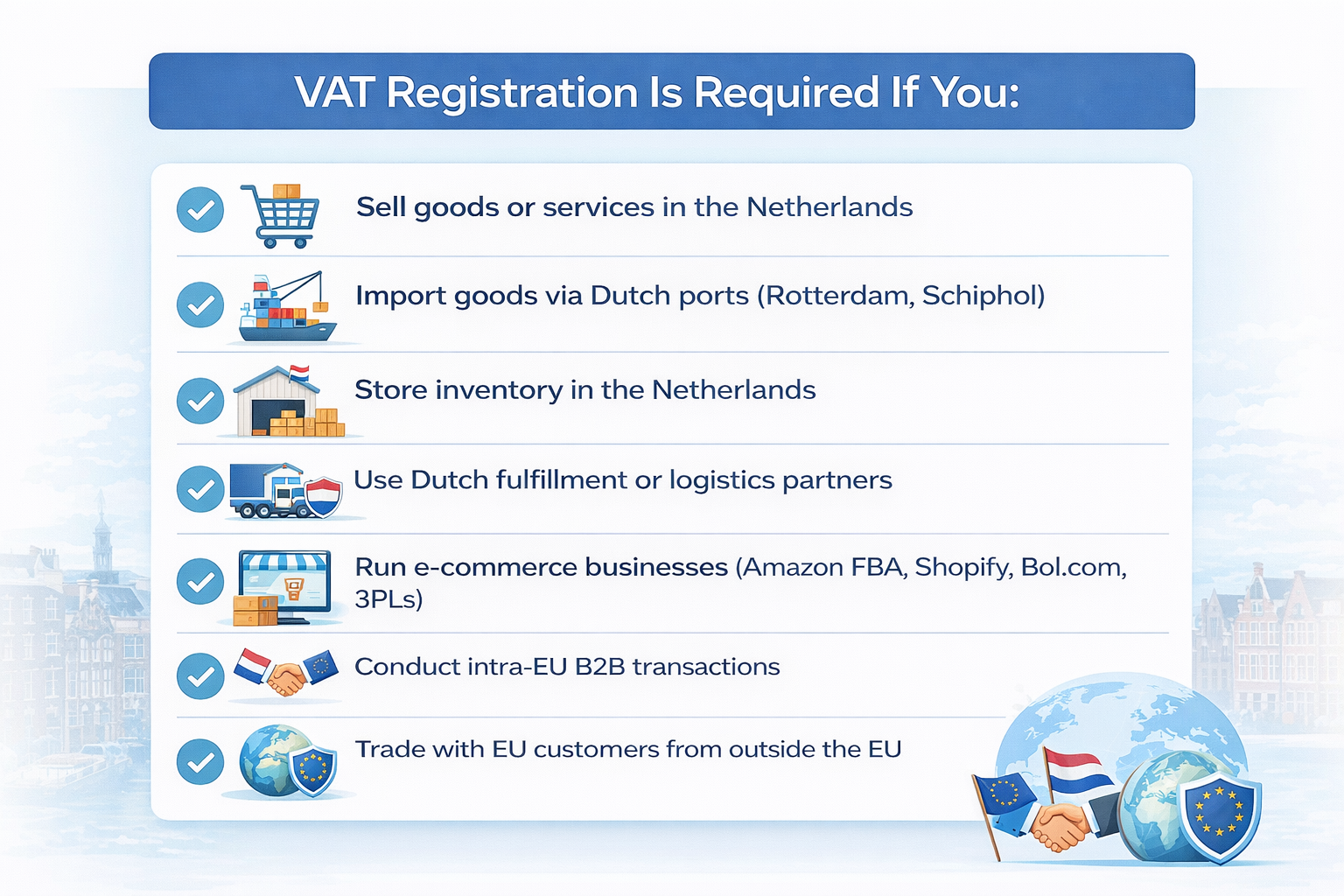
- Sell goods or services in the Netherlands
- Import goods via Dutch ports (Rotterdam, Schiphol)
- Store inventory in the Netherlands
- Use Dutch fulfillment or logistics partners
- Run e-commerce businesses (Amazon FBA, Shopify, Bol.com, 3PLs)
- Conduct intra-EU B2B transactions
- Trade with EU customers from outside the EU
VAT registration is also required when you store inventory in the Netherlands or work with Dutch fulfillment and logistics partners. This is very common for e-commerce businesses using Amazon FBA, Shopify, Bol.com, or third-party warehouses. Intra-EU B2B transactions, where goods or services move between EU member states, are another clear case where VAT registration is necessary.
Non-EU companies often assume they can delay VAT registration until sales increase. In practice, Dutch tax rules expect VAT to be in place before trading starts. Getting this step right early avoids blocked shipments, rejected invoices, and delays with EU partners.
What Is the VAT Rate in the Netherlands?
The VAT rate in the Netherlands depends on what you sell, but most businesses deal with the standard VAT rate of 21%. This is the default rate applied to the majority of goods and services, including professional services, software, electronics, consumer products, and online sales.
When people ask “what is the VAT rate in Netherlands?”, this 21% rate is usually the answer they’re looking for. It applies whether you sell to Dutch customers or invoice EU clients, unless a specific exemption or reduced rate applies.
For international founders, the important part is not just knowing the percentage, but knowing when and how to apply it correctly. Charging the wrong VAT rate can cause invoice rejections, customer disputes, or corrections from the Belastingdienst later on. This is especially relevant for cross-border EU sales, where VAT treatment depends on customer type (B2B or B2C) and location.
This is where proper VAT setup and guidance matters. Getting the VAT rate right from the start keeps your pricing clean, your invoices compliant, and your operations smooth as you scale across Europe.
Different VAT Rates in the Netherlands (Standard, Reduced & Zero Rate)
The Netherlands uses three main VAT rates, depending on the type of goods or services you provide. While most businesses fall under the standard rate, some sectors benefit from reduced or zero VAT.
The standard VAT rate is 21%. This applies to most commercial activities such as consulting, SaaS, electronics, fashion, consumer goods, and general e-commerce. If nothing special is mentioned in Dutch tax rules for your product or service, this is the rate that applies.
The reduced VAT rate is 9% and is mainly used for essential goods and services. Examples include food and beverages (excluding alcohol), medicines, books, newspapers, hotel accommodation, and certain labor services. Businesses in these sectors must clearly justify the use of the reduced rate on their invoices and records.
The 0% VAT rate applies in specific situations, mainly for intra-EU B2B transactions and exports outside the EU. In these cases, VAT is not charged on the invoice, but strict documentation and reporting rules apply. Incorrect use of the 0% rate is one of the most common reasons for VAT corrections by the Dutch tax authority.
Choosing the correct VAT rate is not about preference — it is about classification. This is why many international founders prefer having local guidance before issuing invoices or setting up pricing models for Europe.
How to Get a Dutch VAT Number as a Foreign Company
Getting a Dutch VAT number as a foreign company is very common, especially for businesses using the Netherlands as their entry point into Europe. You do not need to be physically present in the country to register for VAT, but the process must be handled correctly.
If your company is established in the Netherlands, VAT registration usually follows automatically after KVK registration. For foreign companies without a Dutch entity, VAT registration is still possible when you trade, import goods, store inventory, or sell to EU customers through the Netherlands.This is often combined with Netherlands company registration services when founders want a fully compliant setup from the start.
The Dutch Tax Authority requires company documents, business activity details, and sometimes proof of commercial intent before issuing a VAT number. For non-EU businesses, a fiscal representative may also be required, depending on the structure and activities. This is where many founders get stuck, as requirements can differ based on country and business model.
To avoid delays and back-and-forth with the Belastingdienst, most international founders work with a local partner who already understands these rules. The registration can be completed remotely, and once approved, your VAT number becomes active for invoicing, imports, and EU trade.
Article 23 – Import VAT Deferment Explained Simply
Article 23 is a special Dutch VAT facility that allows businesses to defer import VAT instead of paying it upfront when goods enter the Netherlands. In normal situations, import VAT is paid immediately at customs, which can lock a lot of cash. Article 23 removes that pressure.
With an Article 23 permit, import VAT is shifted to your VAT return. This means the VAT is declared and reclaimed in the same return, resulting in no direct cash outflow at the time of import. For companies importing goods via Dutch ports like Rotterdam or Schiphol, this setup can make a big difference to working capital.
This facility is especially useful for e-commerce sellers, wholesalers, distributors, and international brands using the Netherlands as their EU logistics hub. Without Article 23, many businesses end up paying large VAT amounts upfront and waiting months for refunds.
Once your VAT registration is active, an Article 23 application can be submitted to the Belastingdienst. Approval depends on correct VAT setup and compliance readiness. This is why most international founders arrange Article 23 together with VAT registration, rather than as a later fix.
How FirmNL Handles VAT Registration & Compliance for You
VAT in the Netherlands looks simple on the surface, but in practice it involves ongoing filings, correct rate application, and constant alignment with Dutch and EU rules. This is where having a local partner changes everything.
FirmNL supports international founders from the first VAT registration to ongoing compliance. We take care of VAT number registration with the Belastingdienst, handle fiscal representation where required, and make sure your setup matches your actual business activities — not just what looks good on paper.
For companies importing goods, we also assist with Article 23 VAT deferment, so you don’t block cash at customs. As your business grows, our team continues to support VAT returns, intra-EU reporting, and compliance checks, keeping everything clean and audit-ready.
Instead of managing VAT through emails, guesswork, or multiple advisors, founders prefer one point of contact who understands both the Dutch system and international business models. That’s exactly how FirmNL operates — locally present, practical, and focused on helping you scale in Europe without tax headaches.
Also Checkout: How to Start a Business in the Netherlands as a Foreigner?
1. What is VAT in the Netherlands?
VAT in the Netherlands, known as BTW, is a consumption tax charged on most goods and services. Businesses collect VAT from customers and report it to the Dutch Tax Authority. The final tax burden is carried by the end consumer, not the business itself.
2. What is the VAT rate in the Netherlands?
The standard VAT rate in the Netherlands is 21% and applies to most goods and services. A reduced rate of 9% applies to essentials like food, books, and hotel stays. Certain EU exports and B2B transactions qualify for 0% VAT, subject to conditions.
3. Do foreign companies need a VAT number in the Netherlands?
Yes, foreign companies need a Dutch VAT number if they sell goods or services in the Netherlands, import goods through Dutch ports, store inventory locally, or trade with EU customers. Physical presence in the Netherlands is not required for VAT registration.
4. How long does it take to get a VAT number in the Netherlands?
VAT registration timelines depend on the business structure and documentation. For most companies, approval takes a few weeks after submission to the Belastingdienst. Correct setup from the start helps avoid delays and follow-up requests.



Ready to Launch
Your

Dutch Business
Dutch
Business
FirmNL specializes in helping foreign entrepreneurs establish a presence across the EU. From Dutch BV incorporation to tax compliance, sales outsourcing and EU fulfillment — we provide solutions tailored to your goals.