How to Establish a Sole Proprietorship in the Netherlands
4 Min
January 14, 2026
Author:
Garry
.png)
We speak with founders every week who want to start small in the Netherlands. Most of them ask the same question first: Can I start as a sole proprietor instead of setting up a BV?
In many cases, the answer is yes. A sole proprietorship in the Netherlands, also called Eenmanszaak, is one of the simplest and fastest ways to start a business here.
This structure works very well if you are a freelancer, consultant, independent professional, or running a small service-based business. It has low setup cost, less paperwork, and faster registration compared to a company structure. That is why many first-time founders choose this route.
At the same time, we always explain this clearly on calls: a sole proprietorship is not for everyone. Tax rules, liability, and residency status matter a lot. Founders can also compare the types of legal entities in the Netherlands before choosing a structure. This is where founders usually get confused, especially international founders who are new to Dutch rules.
Here we explain the full process in a simple way. No legal language. No confusing terms. Just how it actually works on the ground in the Netherlands, based on what we handle daily at FirmNL.
Let’s start by first understanding what a sole proprietorship really means in the Dutch system.
What Is a Sole Proprietorship (Eenmanszaak) in the Netherlands?
In the Netherlands, a sole proprietorship is known as an Eenmanszaak. It is the most basic business form under Dutch law. In simple words, the business and the owner are treated as one. There is no separate legal entity like a BV.
This means all profits belong directly to you. At the same time, all responsibilities also stay with you. There is no legal wall between personal and business assets. We always explain this early, because many founders assume “business is separate,” which is not the case here.
An Eenmanszaak does not require share capital. There is no notary involved. Registration is done directly with the Dutch Chamber of Commerce. That is why setup is fast. In many cases, the business becomes active within days.
From a tax point of view, income from a sole proprietorship is taxed under personal income tax, not corporate tax. You may also qualify for certain tax deductions if you meet activity and hour requirements. This makes it attractive for freelancers and small operators in the early stage.
We usually recommend sole proprietorship only when the business model is simple, risk is limited, and operations are straightforward. Once things grow, structure choice becomes more important, but we will come to that later.
Who Can Register a Sole Proprietorship in the Netherlands? (Residents vs Foreigners)
This is one of the most important sections, because this is where most confusion happens. At FirmNL, we spend a lot of time explaining this clearly to founders before they take any step.
To register a sole proprietorship in the Netherlands, you must be legally allowed to live and work in the country. In practice, this means residency matters a lot. Dutch citizens and EU/EEA residents usually face no issue here. They can register an Eenmanszaak directly with the Chamber of Commerce.
For non-EU founders, the situation is different. You cannot register a sole proprietorship unless you have a valid Dutch residence permit that allows self-employment. Tourist visas, short-stay visas, or remote-only status do not qualify. We see many founders assume they can “start first and fix visa later,” but Dutch authorities do not allow that.
Another important point many people miss: a sole proprietorship requires a Dutch residential address. Virtual offices or overseas addresses are not accepted for this structure. This rule alone disqualifies many foreign founders who plan to operate fully remotely.
Because of these restrictions, we often guide non-EU founders toward a Dutch BV instead, even if they initially prefer a sole proprietorship. The structure must match immigration and compliance reality, not just preference.
Step-by-Step Process to Register a Sole Proprietorship
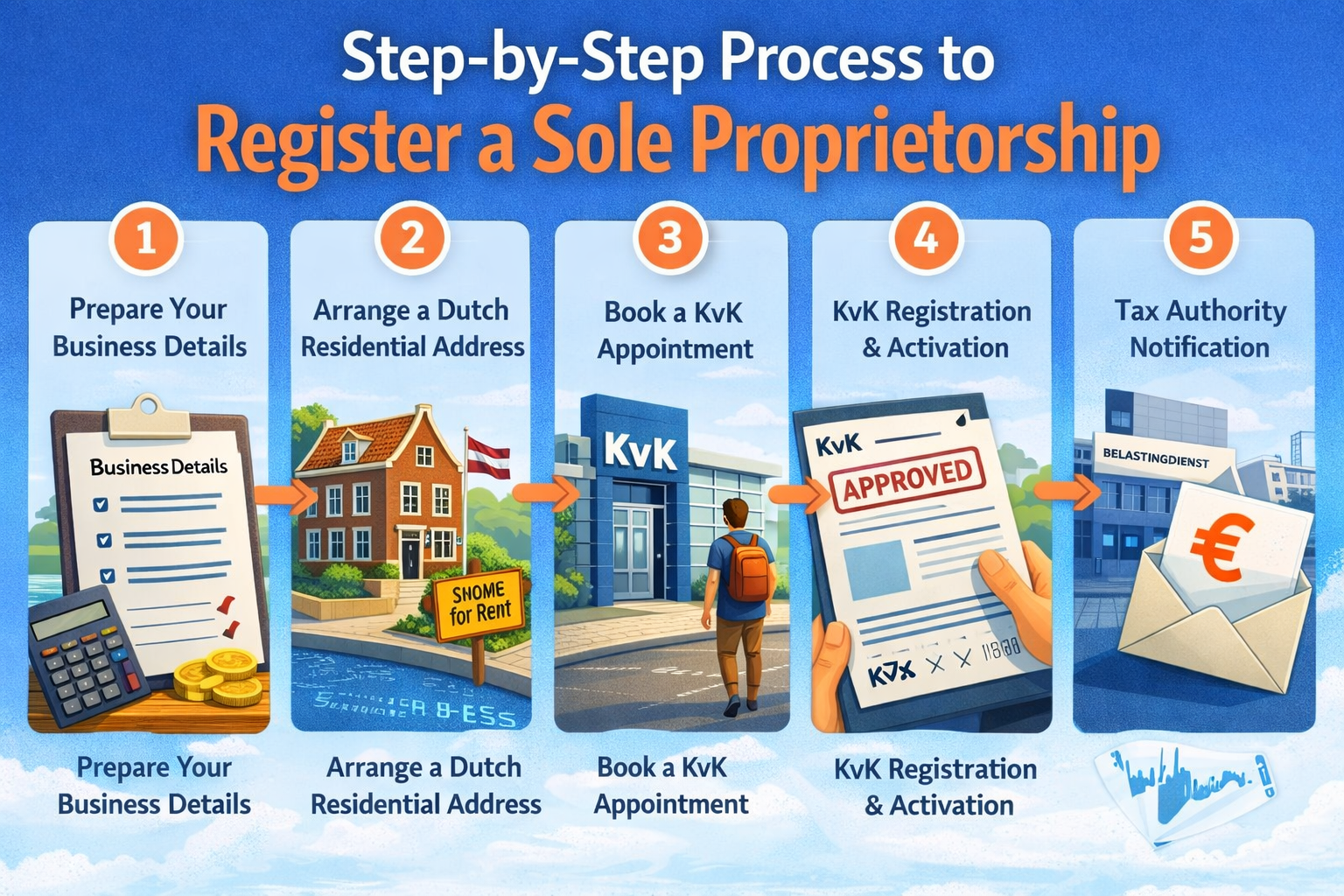
Now let’s break the process down in a practical way. This is how sole proprietorship registration actually works in the Netherlands, based on what we handle daily at FirmNL.
Step 1: Prepare your basic details
Before anything else, you need clarity on your business activity. Dutch authorities ask very specific questions about what you will do, who your clients are, and how you will earn money. Vague descriptions often create delays. We always help founders frame this correctly from day one.
Step 2: Arrange a Dutch residential address
A sole proprietorship requires a Dutch home address. This must be a real residential address where you are registered with the municipality. Commercial or virtual addresses do not work here. Many applications stop at this point because this requirement is not met.
Step 3: Book an appointment with the Chamber of Commerce (KvK)
Registration is done through the Dutch Chamber of Commerce. You must attend the appointment in person. During the meeting, KvK verifies your identity, address, and business activity. The appointment usually takes 30 to 45 minutes.
Step 4: KvK registration and business activation
Once the registration is approved, your business is officially created. You receive a KvK number immediately. This number is used everywhere — invoices, contracts, banks, and tax authorities.
Step 5: Tax authority notification
After KvK registration, your details are shared automatically with the Dutch tax office. Based on your activity, they decide whether a VAT number is required. In most cases, VAT registration follows shortly after.
From outside, this process looks simple. In reality, small mistakes can delay or block registration. That is why we always recommend doing this with local guidance, especially if you are new to Dutch systems.
Chamber of Commerce (KvK) Registration Explained
The Chamber of Commerce, known as KvK, plays a central role in registering a sole proprietorship in the Netherlands. This is not just a formality. This one appointment decides whether your business gets approved or delayed.
During the KvK appointment, the officer checks three main things: your identity, your residential address, and your business activity. They want to clearly understand what you will do and whether it qualifies as an active business under Dutch rules. If answers sound unclear or inconsistent, they may ask follow-up questions or request additional explanation.
One thing many founders don’t expect is that KvK looks at real intent. They want to see that the business is not just an idea, but something you are actually starting. Simple proof like client discussions, a website draft, or a clear service description helps a lot. We often prepare founders for these questions in advance, so nothing feels confusing at the desk.
The registration fee is paid directly at KvK, and once approved, your KvK number is issued immediately. From that moment, your sole proprietorship legally exists. Banks, payment providers, and tax authorities all use this number as your primary business reference.
At FirmNL, we guide founders before this appointment, so they know exactly what to say, what documents to carry, and how to explain their activity in a way Dutch authorities expect. That preparation alone saves weeks of back and forth.
Also Checkout: Sole Trader vs Company in Netherlands – A Quick Comparison
VAT Number, Tax Obligations & Compliance for Sole Traders
Once your sole proprietorship is registered with the KvK, tax compliance becomes the next important part. This is where many founders feel lost, especially in the first few months. We keep this very practical.
After KvK registration, your details are automatically shared with the Dutch Tax Authority. Based on your business activity, they decide if you need a VAT number (BTW-nummer). For most service providers, consultants, freelancers, and traders, VAT registration is required. You usually receive your VAT number within a few weeks.
As a sole trader, you file VAT returns on a monthly or quarterly basis. This includes charging VAT on invoices, collecting it from clients, and paying it to the tax office after deducting eligible expenses. Late filings or wrong VAT handling can quickly lead to penalties. We see this happen often when founders try to manage VAT without local knowledge.
Income tax works differently. Profit from a sole proprietorship is taxed under personal income tax, not corporate tax. Depending on your situation, you may qualify for tax deductions like entrepreneur allowance or small business relief. These benefits only apply if reporting is done correctly and on time.
Compliance does not end at registration. You must keep proper records, issue correct invoices, and file returns every year. This is exactly where FirmNL supports sole proprietors with accounting, VAT filing, and ongoing compliance, so founders can focus on running the business instead of learning tax rules the hard way.
How FirmNL Supports Sole Proprietors in the Netherlands (Accounting, VAT, Growth)
Registering a sole proprietorship is only the first step. What really matters is how you manage it after registration. This is where most founders struggle, and this is exactly where we support at FirmNL.
We work as a local partner, not just a setup service. Once your Eenmanszaak is active, we help you stay compliant from day one. This includes VAT filings, accounting & bookkeeping, income tax preparation, and ongoing reporting. Everything is handled in a way Dutch authorities expect, so you don’t face issues later.
For many founders, accounting becomes confusing after a few months. Invoices, VAT rules, deductible expenses, quarterly filings — small mistakes can create big problems. We handle this in a structured way and explain things in simple English, so you always know what is happening with your numbers.
If your business starts growing, we also help you plan ahead. That includes advice on tax efficiency, compliance planning, and operational setup. Our goal is not just to “register and disappear,” but to support you as your business runs and scales in the Netherlands.


Ready to Launch
Your

Dutch Business
Dutch
Business
FirmNL specializes in helping foreign entrepreneurs establish a presence across the EU. From Dutch BV incorporation to tax compliance, sales outsourcing and EU fulfillment — we provide solutions tailored to your goals.