How to Close a Company in The Netherlands?
4 Min
March 12, 2026
Author:
Gsrry
.png)
Closing a company in the Netherlands is not just about stopping operations. There are several legal and tax steps that must be completed properly before a Dutch BV can officially be terminated. Many international founders assume that once the business stops trading, the company automatically closes. In reality, Dutch law requires formal dissolution, settlement of finances, tax filings, and deregistration with the Dutch Chamber of Commerce (KVK). If these steps are not handled correctly, directors or shareholders can still face legal or tax responsibilities even after the business stops operating.
At FirmNL, we regularly help international founders who decide to shut down their Dutch company for reasons such as restructuring, moving operations to another country, closing an unsuccessful venture, or completing a project-based business. Ending a company is a structured legal process in the Netherlands, and handling it properly avoids penalties, tax complications, and future liabilities.
What Does Terminating a Company in the Netherlands Mean?
When people say they want to “close” a company in the Netherlands, legally it means dissolving the company and completing the liquidation process. For a Dutch private limited company (BV), this process involves formally ending the legal entity and settling all financial and administrative obligations. Simply stopping business activities is not enough. The company continues to exist legally until the dissolution and deregistration process is completed.
In most cases, terminating a Dutch BV includes several connected steps. First, the shareholders must take a formal decision to dissolve the company. After that, the company must settle its finances — meaning assets are liquidated, debts are paid, contracts are closed, and obligations are fulfilled. Once these matters are resolved, the company can be deregistered from the Dutch Chamber of Commerce (KVK). The Tax Administration will then process final corporate tax and VAT matters.
This is where many founders get confused. A company can technically stop trading today, but from a legal perspective the BV still exists until the dissolution process is officially completed. That is why compliance, tax settlement, and proper documentation are essential when shutting down a company in the Netherlands.
Shareholder Decision to Dissolve a Dutch BV
The first legal step in terminating a company in the Netherlands is the formal decision to dissolve the BV. Under Dutch corporate law, a private limited company cannot simply be closed by the director alone. The decision must be approved by the General Meeting of Shareholders (GMS).
If the company has multiple shareholders, the voting requirements and procedure for dissolution are usually defined in the articles of association of the company. In many cases, a majority vote of shareholders is required to approve the dissolution. Some companies may also have additional agreements written in a shareholder agreement that outline how profits, liabilities, and remaining assets should be handled when the company closes.
During this meeting, shareholders formally decide:
- That the company will be dissolved
- The official dissolution date
- Who will act as the liquidator responsible for completing the closing process
In many Dutch BVs, the director automatically becomes the liquidator unless shareholders appoint someone else. The liquidator then becomes responsible for settling assets, paying debts, completing tax filings, and handling the remaining administrative work required to terminate the company.
For international founders, this step can sometimes be confusing, especially if the shareholders are located in different countries.
At FirmNL, we assist clients by preparing the shareholder resolution documents, liquidation decisions, and compliance paperwork required to legally start the company termination process in the Netherlands.
Preparing Final Financial Statements and Settling Assets
Before a Dutch BV can be fully terminated, the company must prepare a final financial balance sheet. This document shows the complete financial position of the company at the time of closure — including assets, liabilities, outstanding payments, and obligations. In many cases, founders work with a bookkeeper or accountant to prepare this final balance. Businesses can also use professional accounting and bookkeeping services in the Netherlands to organize the final financial position and supporting records.
The purpose of this step is to ensure that everything inside the company is financially settled before the BV is closed. This usually includes several practical actions such as:
- Liquidating or distributing company assets
- Repaying loans or financing agreements
- Settling outstanding invoices with suppliers
- Closing lease agreements or service contracts
- Transferring assets such as vehicles or equipment if they belong to the company
If the company still owns assets, those assets must be converted into cash or distributed to shareholders after all debts are paid. Only after this financial settlement can the liquidation process move forward.
This is also the stage where founders must carefully review liabilities and guarantees. For example, if the company has loans, leasing agreements, or financial commitments, those must be settled or transferred before the BV is closed. Ignoring these obligations can create legal issues later, especially for directors.
Handling Employees, Contracts, and Liabilities Before Closing a Company
Before a Dutch company can be fully terminated, the business must settle its employment obligations, contracts, and liabilities. Dutch law requires companies to properly manage these responsibilities before the liquidation process is completed.
If the company has employees, specific rules apply when dismissing staff. In most situations, the employer must apply for a dismissal permit through UWV (Employee Insurance Agency) before terminating employment contracts. Employers may also need to provide a transition payment or severance compensation depending on the employment agreements and Dutch labour law. Companies should also inform the Dutch Tax Administration once employees are dismissed so payroll tax obligations can be closed.
At the same time, the company should review all active agreements with customers, suppliers, and service providers. These contracts may include lease agreements, software subscriptions, logistics contracts, or supplier arrangements. Each agreement must be terminated or fulfilled according to its contractual terms before the company can close operations.
Another important point is outstanding liabilities or debts. If the BV still has debts, the company must attempt to settle them before completing the dissolution. In situations where the company cannot pay its debts, the director may need to consider debt restructuring, suspension of payment, or bankruptcy procedures instead of voluntary liquidation.
This stage is often where many founders face complications, especially if the company has multiple contracts or international operations. At FirmNL, we help founders review their contract obligations, employee matters, and financial liabilities to ensure everything is properly handled before proceeding with the legal dissolution of the company.
Dissolving the BV (Liquidation Process)
Once financial matters, contracts, and obligations are addressed, the company can move to the formal dissolution stage, also known as liquidation. In the Netherlands, a BV is legally ended when the General Meeting of Shareholders officially decides to dissolve the company and registers that decision.
After the dissolution decision, the process usually follows one of two situations.
1. BV with no assets (Turbo Liquidation)
If the company has no remaining assets at the time of dissolution, the BV can be closed quickly through what is commonly known as turbo liquidation. In this case, once the shareholders decide to dissolve the company and it is registered with the Dutch Chamber of Commerce (KVK), the company stops existing immediately. This method is often used when the company has already stopped operations and all finances are settled.
2. BV with assets (Regular liquidation)
If the company still has assets, the liquidation process must continue after dissolution. A liquidator is appointed to settle the company’s remaining financial matters. This includes converting assets into cash, paying remaining debts, and distributing any remaining funds to shareholders.
During this process, the company temporarily continues to exist for the purpose of completing the liquidation. Once all obligations are settled and no assets remain, the liquidation can be finalized.
For foreign founders, the distinction between these two situations is important. A company with unresolved assets or debts cannot simply use turbo liquidation.
Deregistering the Company from the Dutch Chamber of Commerce (KVK)
After the dissolution decision is taken, the next important step is deregistering the company from the Dutch Business Register maintained by the Chamber of Commerce (KVK). This step officially records that the company has ended its activities.
The dissolution decision made by the shareholders must be reported to KVK, usually by the director or the appointed liquidator. Once the deregistration is submitted, KVK updates the Business Register to show that the company has been dissolved.
After this update, KVK automatically informs the Dutch Tax Administration (Belastingdienst) that the company has been terminated. The tax authorities will then send a notification explaining what tax filings still need to be completed before the company is fully closed.
It is important to understand that deregistering the BV can also affect other operational matters. For example:
- Business bank accounts may be closed
- Insurance policies may be cancelled
- Financing agreements may be terminated
- Municipal permits may become invalid
Because of this, founders should carefully review all operational matters before completing the deregistration.
Final VAT Return and Corporate Tax Obligations
Even after the company is deregistered from the Dutch Chamber of Commerce (KVK), the tax process is not finished yet. The Dutch Tax Administration (Belastingdienst) will send an official notification explaining which final tax filings must still be completed before the company is fully closed.
One of the most important requirements is submitting the final VAT return. This is particularly important for businesses that previously registered for a Dutch VAT number and continued to file VAT returns during their operations. After KVK informs the tax authorities that the BV has been dissolved, the Tax Administration will request the company’s last VAT declaration. Only after this return is submitted and processed will the company be officially deregistered as a VAT entrepreneur.
In addition to VAT, the company must also submit its final corporate income tax return (vennootschapsbelasting – VPB). This tax filing covers the final financial year of the company and confirms that all profits, losses, and financial transactions have been reported correctly before the company closes.
There are also situations where additional tax matters must be reviewed. For example:
- If the company owns business property, tax settlement may apply if the value has increased.
- If the director is also a major shareholder (DGA) receiving salary or dividends, income tax rules may apply.
- If assets were distributed to shareholders, tax implications may arise depending on the structure.
Many founders underestimate this stage and assume that deregistration alone closes the tax obligations. In reality, the company remains responsible for completing its final VAT and corporate tax filings before the closure process is fully finalized.
Record Keeping Requirements After Closing a Company
Even after a Dutch BV has been dissolved and deregistered, the company’s administrative obligations do not completely disappear. Dutch law requires businesses to keep their financial and administrative records for several years after the company is closed. In many cases, companies continue to rely on professional accounting services to properly organize and store these records after closure.
In most cases, company records must be kept for at least 7 years. Some documents related to property, international transactions, or tax matters may need to be kept for up to 10 years depending on the situation. These records include:
- Accounting records and financial statements
- VAT filings and tax documents
- Contracts and agreements
- Payroll administration (if the company had employees)
- Shareholder resolutions and company documents
Proper understanding of Dutch BV accounting standards can also help ensure that financial records and annual reporting obligations have been handled correctly before and after closure.
During the dissolution process, shareholders must appoint a person responsible for keeping these records. This is usually the liquidator or a director of the company. The appointed record keeper must also be registered with the Business Register when the company is deregistered.
Another important point is that companies must ensure all required financial statements from previous years have been filed and published with the Dutch Chamber of Commerce. If annual accounts were not filed before closing the company, directors may face fines or even personal liability in certain situations.
For international founders, this step is often overlooked, especially when the company was operated remotely. At FirmNL, we help clients ensure that company records, compliance documents, and financial statements are properly maintained and stored after closure, so founders remain compliant with Dutch regulations even after the business ends.
Common Mistakes Foreign Founders Make When Closing a Company in the Netherlands
Closing a company in the Netherlands may seem straightforward, but in practice many founders make mistakes that later create legal, tax, or compliance problems. We often see this when international entrepreneurs assume that stopping business activity automatically closes the company. Unfortunately, that is not how Dutch corporate law works.
One common mistake is not completing the formal dissolution process. A company may stop trading, but if the shareholders never officially approve the dissolution and register it with KVK, the BV still legally exists. This means tax filings and compliance obligations may continue.
Another issue we often see is ignoring final tax filings. Some founders deregister their company but forget about the final VAT return or corporate income tax declaration. The Dutch Tax Administration can still send notices or penalties if these obligations are not completed properly.
There are also situations where founders attempt to close a company using turbo liquidation even though the company still has assets or debts. This can lead to complications or legal challenges later if creditors believe the company was closed incorrectly.
Foreign founders also sometimes overlook employee obligations, contract cancellations, or record-keeping requirements. Dutch regulations require proper handling of staff dismissals, contract termination, and record storage even after the company closes.
How FirmNL Helps with Company Termination in the Netherlands
For many international founders, terminating a Dutch company is not only a legal task but also an administrative and tax challenge. The process involves shareholder decisions, financial settlements, tax filings, and coordination with multiple Dutch authorities. If these steps are not handled correctly, the company may remain active in government records or continue receiving tax notices even after operations stop.
At FirmNL, we support founders with a structured and compliant company termination process in the Netherlands. Because our team works directly with Dutch regulations, tax procedures, and the Chamber of Commerce system, we help businesses close their companies without unnecessary complications.
Our support typically includes:
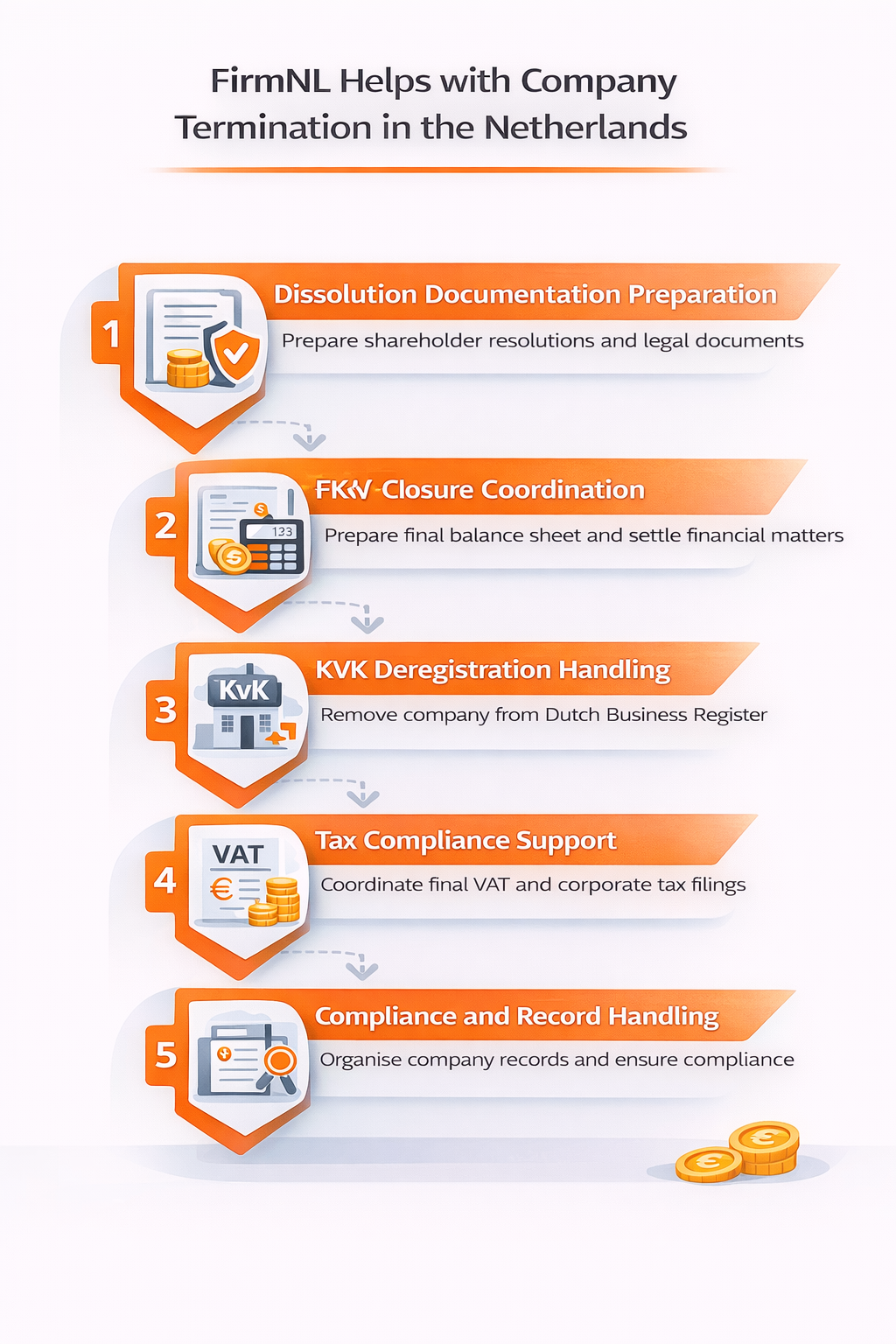
1. Dissolution Documentation Preparation
We prepare the required shareholder resolutions and legal documents needed to formally dissolve the Dutch BV.
2. Financial Closure Coordination
We work together with accountants to prepare the final balance sheet and ensure assets, liabilities, and financial matters are settled before liquidation.
3. KVK Deregistration Handling
Our team manages the process of deregistering the company from the Dutch Chamber of Commerce (KVK) so the business is officially removed from the Business Register.
4. Tax Compliance Support
We coordinate the final VAT return and corporate tax filings with accountants to ensure the company meets its tax obligations before closure.
5. Compliance and Record Handling
We help founders organise company records, appoint a records keeper, and ensure compliance requirements are fulfilled even after the company is closed.
Many international founders operate their Dutch BV remotely and are not always familiar with the local administrative procedures. In such cases, FirmNL acts as a local compliance partner in the Netherlands, helping manage the entire termination process from start to finish.
This approach ensures that the company is closed properly, taxes are settled, and founders can move forward without lingering legal or compliance issues.



Ready to Launch
Your

Dutch Business
Dutch
Business
FirmNL specializes in helping foreign entrepreneurs establish a presence across the EU. From Dutch BV incorporation to tax compliance, sales outsourcing and EU fulfillment — we provide solutions tailored to your goals.