Type of Legal Entities in the Netherlands | Dutch Business Structures
4 Min
December 29, 2025
Author:
Garry
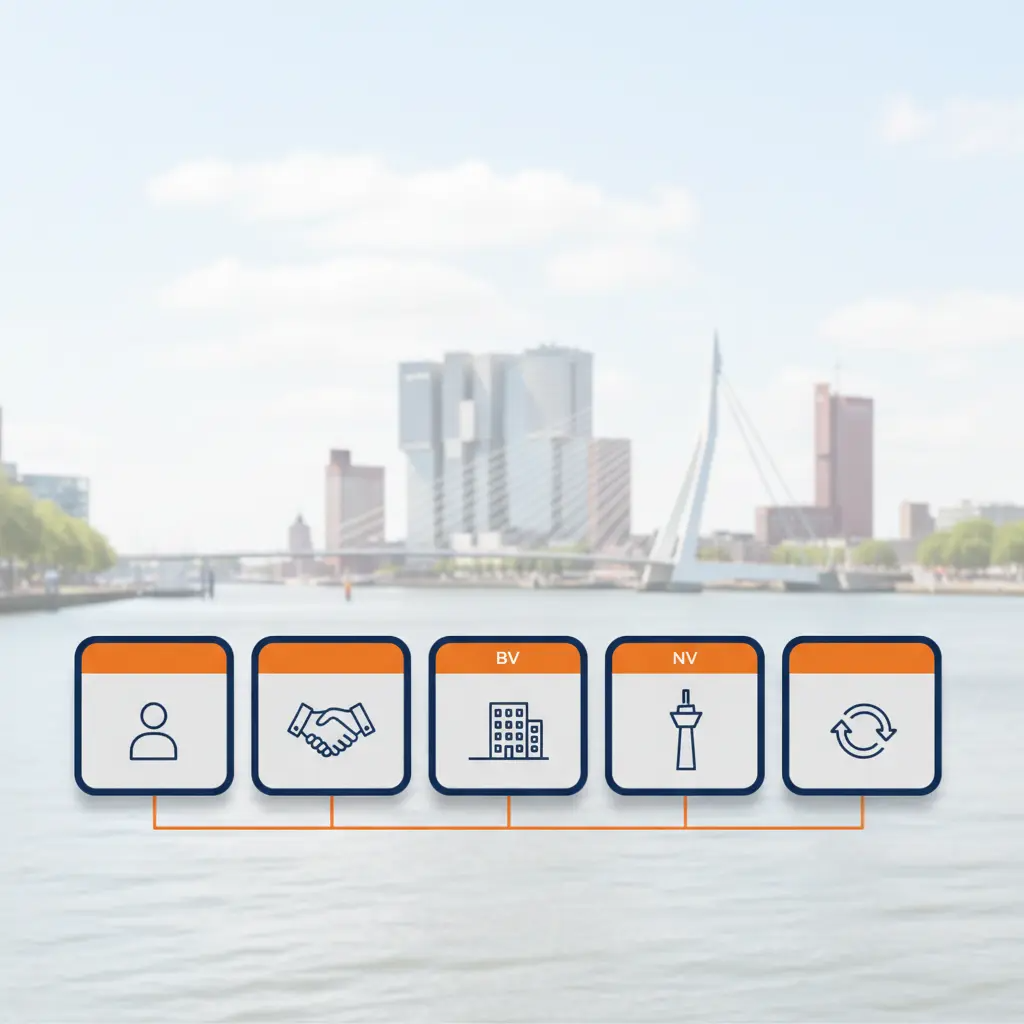
Before registering any company in the Netherlands, one decision matters more than most founders realise: choosing the right legal entity. We see many international founders focus only on speed or cost. Later, they face issues with taxes, banking, liability, or even client trust. This usually happens because the structure was chosen without understanding how the Dutch system works.
The Netherlands offers several business structures, but not all of them are suitable for every business. Some are designed for freelancers, some for large corporations, and some only for very specific purposes. Picking the wrong one can limit growth or increase personal risk, even if the registration itself looks simple.
At FirmNL, we always explain this clearly on the first call. There is no “best” structure for everyone. There is only the structure that fits your business model, risk level, and expansion plan. In this blog, we explain the main Dutch business structures that actually matter for founders, in simple language and real-world terms.
1. Dutch BV (Private Limited Company) – The Standard Choice for Most Businesses
For most international founders, the Dutch BV incorporation is the structure that makes the most sense. It is also the most commonly used legal entity in the Netherlands for startups, SMEs, and foreign-owned businesses. When people talk about “setting up a company in the Netherlands,” in most cases they are talking about a BV.
A Dutch BV gives you limited liability. This means the company is responsible for its debts and risks, not you personally. For founders entering a new market, this protection is critical. Your personal assets stay separate from business operations, which is one of the main reasons founders prefer this structure.
Why founders choose a Dutch BV
- Personal liability is limited to the company
- One or multiple shareholders are allowed
- Shareholders can be foreign individuals or companies
- Strong credibility with banks, clients, and investors
- Fully accepted across the EU for trade and operations
The BV also works well for different business models. Whether you run a SaaS company, e-commerce brand, consulting business, or holding structure, the BV adapts easily. It supports VAT registration, hiring employees, opening EU bank accounts, and raising investment later.
At FirmNL, this is the structure we recommend in most cases, not because it is complex, but because it is stable, trusted, and scalable. For founders who plan to build something serious in the Netherlands or Europe, the Dutch BV usually creates the fewest problems over time.
2. Sole Proprietorship and Partnerships – Simple but Risky Options
Some founders ask us if they can start with a simpler structure instead of a BV. In the Netherlands, these options are mainly the Sole Proprietorship (Eenmanszaak) and partnership-based structures like VOF and CV. On paper, they look easy and low-cost. In practice, they come with risks that many international founders overlook.
A Sole Proprietorship (Eenmanszaak) is linked directly to the individual. There is no legal separation between you and the business. This means unlimited personal liability. If the business faces debts or legal claims, your personal assets are also exposed. For local freelancers, this may be acceptable. For foreign founders entering a new market, it is usually not.
Partnership structures work in a similar way.
A VOF (General Partnership) involves two or more partners who are personally liable for business obligations.
A CV (Limited Partnership) has managing partners with full liability and silent partners with limited risk, but it is still not ideal for most operating businesses.
Why these structures are rarely suitable for international founders
- Personal assets are not protected
- Banking and payment approvals are harder
- Investors usually avoid these structures
- Scaling or converting later becomes messy
- Cross-border tax planning is limited
We often see founders start with these structures to “test the market” and then struggle when they need VAT, banking, or credibility with EU clients. Fixing the structure later usually costs more than doing it right from the beginning.
3. NV (Public Limited Company) – For Large and Capital-Heavy Businesses
The NV (Naamloze Vennootschap) is another legal entity in the Netherlands, but it is not meant for most startups or small businesses. We include it here because many founders hear about it and assume it is a “bigger” or “better” version of a BV. In reality, it serves a very different purpose.
An NV is mainly used by large corporations, companies planning to raise capital from the public, or businesses that want to list shares on a stock exchange. It comes with higher capital expectations, stricter governance, and more regulatory requirements. This makes it unsuitable for early-stage or growth-stage international founders.
When an NV actually makes sense
- You plan to raise capital from public investors
- The business operates at a large, corporate scale
- You need freely transferable shares
- The company is preparing for a stock exchange listing
Why most founders do not need an NV
- Higher setup and maintenance complexity
- More formal governance and reporting rules
- Not required for normal EU operations
- No practical advantage over a BV for SMEs
4. Branch Office vs Dutch Subsidiary
When a foreign company wants to operate in the Netherlands, another common question comes up: should we open a branch office or set up a Dutch subsidiary? On the surface, a branch looks easier. In reality, the difference is more strategic than most founders expect.
A branch office is not a separate legal entity. It is simply an extension of your foreign company. The parent company remains fully responsible for all liabilities, contracts, and risks in the Netherlands. While a branch can work for limited activities, it often creates complications with banking, contracts, and long-term planning.
A Dutch subsidiary, usually set up as a Dutch BV, is a separate legal entity. It operates under Dutch law, even though it may be fully owned by a foreign parent company. This separation is what many EU partners, banks, and authorities prefer.
Key differences founders should understand
- A branch has no limited liability protection from the parent
- A subsidiary limits risk to the Dutch entity
- Banking and payments are easier with a Dutch BV
- Clients and suppliers trust subsidiaries more than branches
- A subsidiary fits better for hiring staff and scaling
5. Foundations and Special Structures (Stichting, Association)
Apart from commercial company structures, the Netherlands also offers special-purpose legal entities. The most common ones founders hear about are the Stichting (Foundation) and Association (Vereniging). These structures are useful, but only in very specific cases.
A Stichting is not designed to run a normal profit-driven business. It does not have shareholders and is usually created for non-profit, charitable, asset-holding, or control purposes. That said, we do see foundations used smartly in holding or IP structures, but only with proper planning.
An Association is mainly used for member-based organisations, clubs, or communities. It is not suitable for startups, trading companies, or international businesses looking to sell products or services in the EU.
When these structures are actually used
- Foundations holding shares or intellectual property
- Non-profit or social initiatives
- Governance or control layers in complex structures
- Member-based organisations (not commercial sales)
Why most founders do not need them
- They are not meant for regular trading
- No shareholders or profit distribution like a company
- Banking and tax setup is more restrictive
- Wrong use can raise compliance questions
6. Which Legal Entity Fits Your Business Model?
By now, you can see that the Netherlands offers multiple legal entities, but only a few of them actually make sense for most founders. The right choice depends less on theory and more on how your business will operate in real life.
This is how we usually guide founders at FirmNL, in simple terms:
A Dutch BV is the right fit if:
- You are an international founder entering the EU market
- You want limited liability and clear risk separation
- You need VAT registration, banking, or EU credibility
- You plan to scale, hire, or raise investment
A sole proprietorship or partnership may work if:
- You are a local freelancer or very small operation
- You fully understand and accept personal liability
- The business is short-term or very limited in scope
An NV only makes sense if:
- You operate at a large corporate level
- You plan public fundraising or stock exchange listing
A branch office may work if:
- You only need a temporary or representative presence
- Revenue, contracts, and risk stay mainly outside the Netherlands
Foundations or associations are suitable if:
- The goal is non-profit, governance, or asset holding
- There is a clear legal and tax reason for using them
Most mistakes happen when founders choose a structure based on speed or assumptions. Fixing it later often costs more than doing it right from the beginning.
This is why we always recommend one thing: choose the structure based on your business model, risk exposure, and long-term plan, not just registration cost.
How FirmNL Helps You Choose and Set Up the Right Structure
Choosing a legal entity in the Netherlands is not just a registration step. It is a strategic decision that affects tax, liability, banking, and how easily you can operate in Europe. This is why, at FirmNL, we never treat company setup as a one-size-fits-all service. After incorporation, proper accounting and bookkeeping also helps keep the business organised and compliant.
We start by understanding how your business actually works. Where your customers are. How revenue flows. Whether you need VAT immediately. Whether you plan to hire, raise investment, or expand across the EU. Based on this, we recommend the structure that fits your business, not just the fastest option.
How we support you at FirmNL
- We assess the most suitable Dutch legal entity for your business
- We explain risks and trade-offs clearly before registration
- We handle full company formation, remotely if needed
- We support VAT, EORI, and compliance setup
- We assist with banking, accounting, and ongoing operations
- We stay involved after incorporation, not just at setup
At FirmNL we help you avoid those problems and build on a solid foundation from day one. If you are planning to enter the Netherlands or the wider EU market and want clarity instead of assumptions, we are here to guide you through the process in a simple and practical way.


Ready to Launch
Your

Dutch Business
Dutch
Business
FirmNL specializes in helping foreign entrepreneurs establish a presence across the EU. From Dutch BV incorporation to tax compliance, sales outsourcing and EU fulfillment — we provide solutions tailored to your goals.