Netherlands Company Registration Process & Requirements
4 Min
December 16, 2025
Author:
Garry
When international founders plan to enter Europe, the Netherlands is often the first serious option they consider. But once the decision is made, the real questions begin — who can register a company, what documents are required, and how the Netherlands company registration process actually works for foreign founders.
At FirmNL, our daily routine involves interacting with foreign founders, and the same misunderstanding keeps rising. This blog will only cover the most basic Netherlands business registration process and specifications, and it will do so in an easy way. Reasons like why the Netherlands is a great place to do business, VAT & EORI registration, KVK details, timelines, and the value of a local partnership have been discussed in more detail in our earlier blogs. The links to those posts are available on our website for you to read them separately. We keep it practical and targeted here, so you know exactly what is required before starting and how the registration process moves forward without delays.
Types of Companies You Can Register in the Netherlands
When foreign founders approach us, the first structural decision is choosing the right company type. In the Netherlands, there are multiple legal forms available, but not all of them make sense for international businesses. At FirmNL, we guide founders based on liability, tax clarity, and how easy the structure is to manage from abroad.
Founders who are still deciding whether the Netherlands is the right jurisdiction can first review our detailed overview on start a business in the Netherlands as a foreigner before choosing a legal structure.
Dutch BV (Besloten Vennootschap) is still the preferred choice for international entrepreneurs because of the limited liability, EU credibility, and flexible ownership and management it offers. In our previous posts, we have mentioned the reasons why most foreign companies end up picking a BV, so we will not make that comparison again in this article.
Main types of companies you can register in the Netherlands:
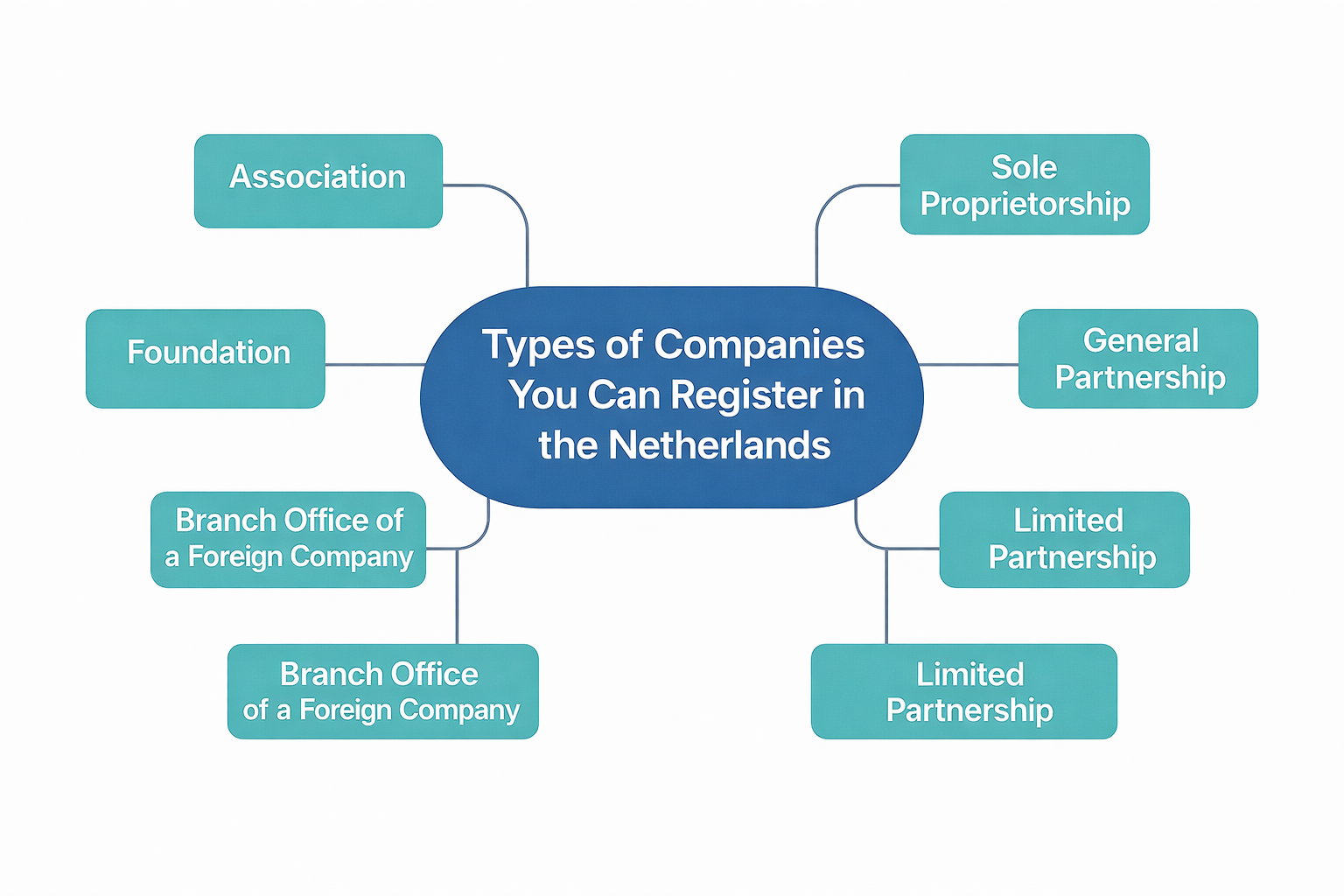
- Dutch BV (Besloten Vennootschap)
- Sole Proprietorship (Eenmanszaak)
- General Partnership (VOF)
- Limited Partnership (CV)
- Branch Office of a Foreign Company
- Foundation (Stichting)
- Association (Vereniging)
Key Requirements for Netherlands Company Registration
Before starting, foreign founders should be clear about the basic Netherlands company registration process & requirements. We always explain these upfront because missing even one requirement can delay incorporation. The good part is that the Netherlands does not ask for complex or unrealistic conditions, but everything must be structured correctly from the start.
For most international founders who incorporate a Dutch BV Online, there is no minimum capital requirement in practice. Moreover, there are no restrictions in terms of residence for both shareholders and directors. It is not a must to be in the Netherlands during the whole process. However, there is a necessity for a registered Dutch commercial address along with properly verified identification documents. We will not go into tax setup and compliance following the KVK registration in our last blog, where we already did, thus limiting this section to core requirements.
Key requirements to register a company in the Netherlands:
- At least one shareholder (individual or company)
- At least one director (can be non-EU and non-resident)
- Valid passport and identity verification for directors and shareholders
- Registered business address in the Netherlands
- Defined company name and business activities
- Share capital structure (minimum capital is not a barrier)
Documents Required for Netherlands Company Registration
When the fundamental specifications are understood, the next stage is document drafting. This is the point where a lot of non-native entrepreneurs encounter waiting periods, predominantly due to the fact that the Dutch government is very precise and rigorous in terms of document inspection. FirmNL ensures that the documents are prepared accurately so that the registration is without any hiccups.
The documentation required is not very complex, but everything needs to correspond perfectly. The documentation required is not very complex, but everything needs to correspond perfectly - names, addresses, and identification particulars should be the same in all the documents.
Documents required to register a company in the Netherlands:
- A copy of the passport of every shareholder and director
- Verification of residential address (utility bill or bank statement)
- Information regarding the date and place of birth
- Details about the shareholding structure
- Proposed company name and a description of the business activity
- Power of attorney (in case of remote incorporation, if applicable)
Step-by-Step Netherlands Company Registration Process
Once all documents are ready, the Netherlands company registration process itself is quite structured. FirmNL follows a clear step-by-step flow so foreign founders know exactly what is happening at each stage. Most importantly, the entire process can be completed remotely, without visiting the Netherlands.
We start with document verification and business assessment to make sure everything aligns with Dutch requirements. After that, the incorporation moves through the notary and official registrations.
Netherlands company registration process steps:
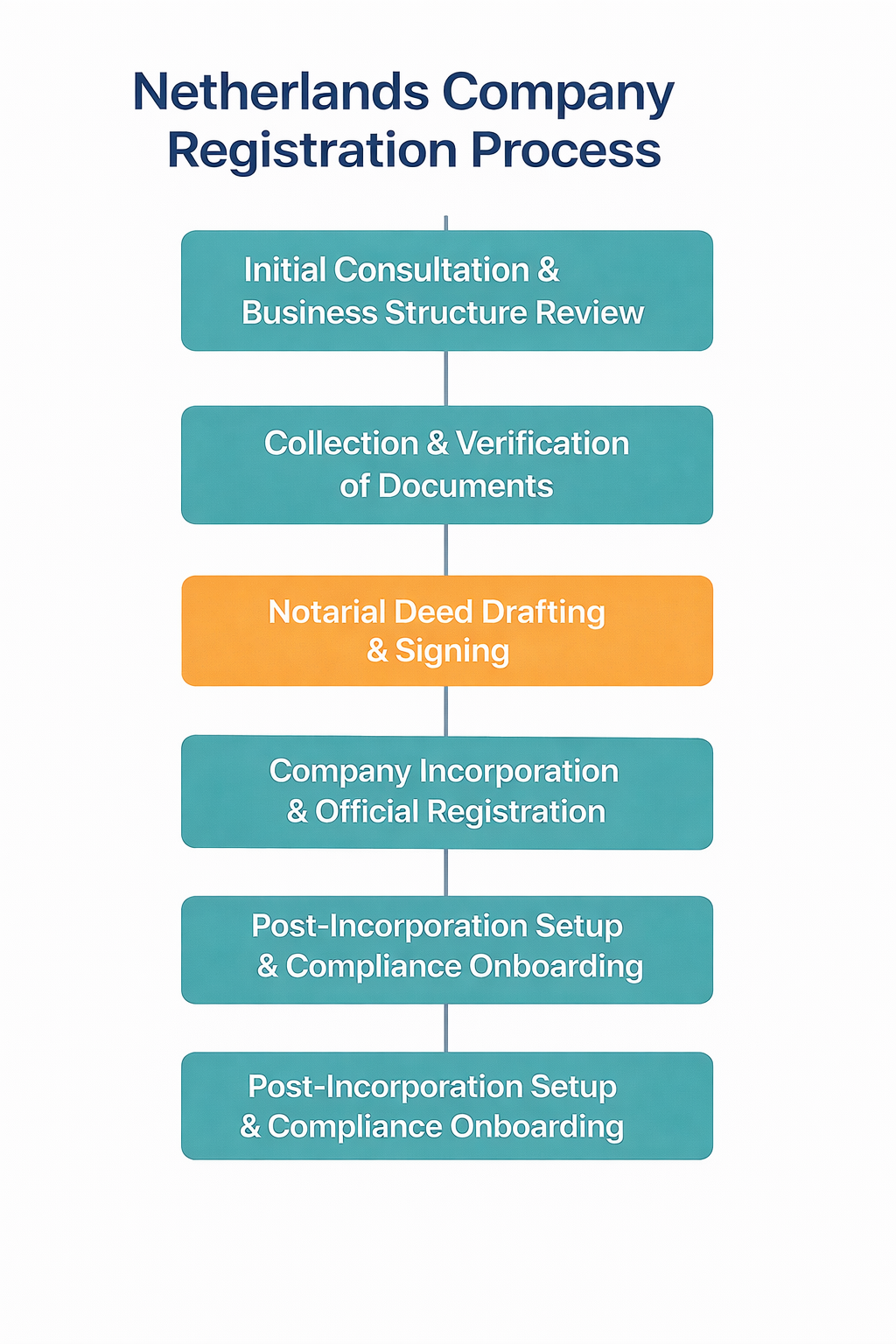
- Initial consultation and business structure review
- Collection and verification of documents
- Notarial deed drafting and signing (remote possible)
- Company incorporation and official registration
- Post-incorporation setup and compliance onboarding
Bank Account Setup for Dutch Companies
After your company is incorporated, the next step is opening a business bank account. The foreign founders usually find themselves frozen at this point, considering the tough onboarding procedures Dutch banks have. We assist and educate the founders beforehand so that the bank applications do not get rejected or postponed.
Dutch banks allow for both traditional and online banking, while the right selection is determined by your business model, country of residence, and projected transactions. Traditional Dutch banks
- EU digital business banks
- Fintech and online banking platforms
- Multi-currency business accounts
Common Challenges Foreign Founders Face During Registration
Even though the Netherlands has a clear legal framework, foreign founders often face problems that are not mentioned on government websites. We see these issues regularly at FirmNL, especially when founders try to manage the process on their own or rely on generic online services. Understanding the full Netherlands company registration process & requirements beforehand is exactly what prevents these issues.
“Most registration delays don’t happen because the Netherlands is complex.
They happen because small details are missed early.”
1. Document Mismatches and Verification Delays
A small difference in name spelling, address format, or document validity can pause the entire process. Dutch notaries and authorities are very strict about consistency. Once a file is flagged, correcting it can take weeks instead of days.
2. Unclear Business Activity Description
Many founders underestimate how important the business activity description is. If it is too broad or unclear, it can create issues later during banking or compliance checks. We usually refine this early so it works both legally and operationally.
3. Banking Rejections After Incorporation
This is one of the most common frustrations. The company gets registered, but the bank account application is rejected due to missing context, risk profiling, or an incomplete background explanation. This is why, in our earlier blogs, we stressed planning banking alongside incorporation.
4. Compliance Confusion After Registration
Some founders believe the process ends once the company is registered. In reality, post-registration compliance starts immediately. Missing early filings or registrations can create avoidable penalties later.
What Happens After Your Company Is Registered
Many founders assume the hardest part is over once the company is officially registered. In reality, registration is just the starting point. What you do right after incorporation decides whether your Dutch company runs smoothly or starts facing friction early.
We usually explain this part very clearly, because most issues we fix later come from things that were ignored in the first few weeks.
The first 30 days matter the most.
Think of this phase as operational activation. Your company exists on paper, but now it needs to function properly.
Here’s how things usually move in practice:
Where founders usually slip up
- They delay setting up accounting because there is “no revenue yet.”
- They don’t align banking and compliance requirements early.
- They start operating without clarity on the ongoing obligations.
This is exactly where small mistakes quietly turn into penalties or operational blocks later.
“A Dutch company is easy to register, but it must be run correctly from day one.”
How We Handle This at FirmNL
Instead of treating registration as a one-time service, we treat it as the foundation phase. Once the company is live, we help founders move into a stable operating mode — accounting-ready, compliance-ready, and business-ready.
This approach avoids future corrections, rework, and unnecessary stress for foreign founders who are managing everything remotely.
How FirmNL Supports You Beyond Company Registration
For us, company registration is not the finish line. It is the starting point of your operations in Europe. At FirmNL, we work with many international founders who register a Dutch company today but plan to grow, sell, or expand across the EU tomorrow. That is why our support does not stop at incorporation.
Once your company is registered, we stay involved in making sure everything runs smoothly in real life, not just on paper. We help founders move from setup mode to operating mode without confusion or delays.
What Ongoing Support Looks Like in Practice
Instead of pushing multiple vendors or outsourcing everything separately, we keep things connected under one roof. This saves founders time and avoids miscommunication between service providers.
Our post-registration support typically includes:
- Accounting and bookkeeping setup with ongoing compliance
- Tax coordination and filing support
- Sales outsourcing for companies entering the EU market
- EU fulfillment and logistics coordination for product-based businesses
- Operational guidance as your business scales
We have already explained specific services like tax registration, banking, and compliance in our earlier blogs. Here, the focus is on continuity making sure your business does not feel “on its own” after registration.
Final Summary: What You Need to Prepare Before Starting
If you are planning to register a company in Netherlands, the process itself is straightforward when it is planned properly. The biggest problems we see at FirmNL are not caused by complex laws, but by missing preparation and unclear expectations.
Before starting, founders should be clear about three things: the right company structure, complete and consistent documentation, and a realistic plan for what happens after registration.
The Netherlands works very well for foreign founders who treat company registration as a business setup process, not just a legal formality. When everything is aligned from day one, operations stay smooth and scalable. This is exactly how we approach every registration at FirmNL — structured, compliant, and ready for growth.



Ready to Launch
Your

Dutch Business
Dutch
Business
FirmNL specializes in helping foreign entrepreneurs establish a presence across the EU. From Dutch BV incorporation to tax compliance, sales outsourcing and EU fulfillment — we provide solutions tailored to your goals.