What Is KIA Allowance in Netherlands and Who Is Eligible?
4 Min
January 22, 2026
Author:
Garry
.png)
Many founders first hear about the KIA allowance from an accountant, a friend, or an online calculator and assume it is a quick tax benefit they can just “apply” for. In reality, KIA is simple on paper, but it becomes tricky in practice if you don’t understand how Dutch tax authorities actually look at investments.
The Small-Scale Investment Allowance (KIA) is not free money and not a subsidy. It is a tax deduction that can reduce your taxable profit when you make qualifying business investments. This means it only works if your business structure, your assets, and your accounting are aligned correctly. We see many businesses miss out on KIA not because they did something illegal, but because they misunderstood the rules.
For Dutch entrepreneurs, KIA is already confusing. For foreign founders running a Dutch BV, it becomes even more unclear. Questions like “Does my BV qualify?”, “Does it matter if I live outside the Netherlands?”, or “Which assets are actually accepted?” come up in almost every consultation we do.
In this article, we explain KIA in clear and simple language, without exaggeration or shortcuts. We focus on who is eligible, what really qualifies, and where businesses usually go wrong. Our goal is not just to explain the rule, but to help you understand how KIA works in real life, the way the Dutch tax authorities expect it to be applied.
This is exactly the approach we follow at FirmNL when we support founders with Dutch accounting, tax compliance, and investment planning — clear, practical, and fully compliant.
What Is the KIA Allowance in the Netherlands?
The KIA allowance, short for Small-Scale Investment Allowance, is a tax deduction available in the Netherlands for businesses that invest in qualifying business assets. It is designed to encourage entrepreneurs to invest in their company by allowing them to deduct an extra amount from their taxable profit, on top of normal depreciation.
It is important to understand one thing clearly: KIA is not a subsidy and not cash back. You do not receive money from the tax office. Instead, your taxable profit goes down, which usually means you pay less income tax or corporate tax.
KIA applies when a business makes capital investments in assets that are used for business purposes and are expected to last for several years. Typical examples include machines, tools, IT equipment, or other durable assets. Day-to-day expenses normally do not fall under KIA.
Another key point many founders miss is that KIA is calculated per financial year, not per asset. This means the total value of all qualifying investments in one year is added together, and the deduction is based on that total amount.
KIA is available for:
- Sole proprietors and partnerships paying income tax, such as entrepreneurs operating a Sole Proprietorship in the Netherlands
- Dutch BVs paying corporate tax
As long as the business is tax-liable in the Netherlands and the investments meet the conditions, KIA can apply. The personal nationality of the founder is not the deciding factor — the tax position of the business is.
This is where many misunderstandings start. On paper, KIA looks straightforward. In practice, eligibility depends on how the asset is used, how it is recorded in the accounts, and whether it meets Dutch tax rules. That is why KIA often works well when planned correctly and causes problems when claimed casually.
Who Is Eligible for the KIA Allowance?
Eligibility for the KIA allowance depends on the business, not on where the founder comes from or where the director lives. This point alone clears up a lot of confusion we see in practice.
In general, a business can be eligible for KIA if it is tax-liable in the Netherlands and makes qualifying investments during the financial year.
KIA is available for:
- Sole proprietors (ZZP) and partnerships paying Dutch income tax
- Dutch BVs paying corporate tax (VPB)
If your business falls into one of these categories, KIA may apply — but only if the other conditions are also met.
For Dutch BVs, including foreign-owned BVs, the key requirement is that the company is:
- Properly registered in the Netherlands
- Actively operating
- Subject to Dutch corporate tax
The nationality of shareholders or directors does not automatically block KIA. What matters is whether the investment is made by the Dutch entity and used for its business activities.
Another important condition is that the investment must be made for business purposes and must be recorded correctly in the accounts as a business asset. For foreign founders, this also means ensuring the correct VAT structure, including whether Article 23 VAT deferral or Fiscal Representation is required. If VAT is handled incorrectly at import or purchase stage, the KIA claim may be questioned even if the asset itself qualifies.
It is also worth noting that KIA applies per financial year. If your total qualifying investments in one year stay below the minimum threshold, no KIA can be claimed, even if individual purchases seem substantial on their own.
In short, many businesses are technically eligible for KIA, but eligibility is confirmed only when:
- The business structure is correct
- The investment meets Dutch tax rules
- The accounting treatment is done properly
Also Checkout: How to Apply for an Artikel 23 License in the Netherlands
KIA Allowance for Dutch BV and Foreign-Owned Companies
This is the area where we see the most confusion, especially among international founders.
A common assumption is that KIA is only meant for Dutch freelancers or locally owned businesses. That is not correct. A Dutch BV can qualify for the KIA allowance, even if the shareholders or directors live outside the Netherlands.
What matters is where the business is taxed, not where the founder is based.
A Dutch BV may be eligible for KIA if:
- The BV is tax resident in the Netherlands
- It is subject to Dutch corporate tax (VPB)
- The investment is made by the Dutch BV
- The asset is used for the BV’s business activities
If these conditions are met, foreign ownership alone does not block access to KIA.
Where problems usually start is in practical execution. For example:
- The asset is purchased personally instead of by the BV
- The asset is mainly used outside the Netherlands
- The investment is not capitalised correctly in the accounts
- The BV exists on paper but lacks real business activity
In these cases, the tax authorities may question whether the investment truly belongs to the Dutch business. This is especially relevant for foreign founders who manage their company remotely.
Another point to be careful with is substance. While KIA does not require heavy substance on its own, the BV must still be a real operating company. If a BV has no clear activity, no staff, and no business logic behind the investment, KIA claims become harder to defend.
This does not mean foreign founders should avoid KIA. It simply means that investments should be:
- Made intentionally
- Clearly linked to the Dutch business
- Properly documented
When structured correctly, KIA works just as well for a foreign-owned Dutch BV as it does for a local business.
Which Investments Qualify for the KIA Allowance?
Not every business expense qualifies for the KIA allowance. KIA only applies to investments in business assets that meet specific Dutch tax conditions. This distinction is important, because many claims fail simply due to incorrect classification.
In simple terms, an investment qualifies for KIA if it is:
- A business asset, not a daily operating expense
- Intended for long-term use in the business
- Depreciable under Dutch tax rules
- Purchased for business purposes
There is also a minimum value rule. Each individual asset must have a purchase value of more than €450. This amount is assessed excluding VAT if VAT can be reclaimed. If VAT cannot be reclaimed, the value including VAT is used instead.
Common examples of assets that may qualify include:
- Machines and production equipment
- Tools and technical installations
- IT equipment such as servers or workstations
- Business-use hardware and infrastructure
For imported assets, especially machinery or technical equipment purchased from outside the EU, the Dutch business must also have a valid EORI number. Without a correct EORI registration, customs clearance and VAT handling can be delayed or incorrect, which may impact whether the investment is properly recognised for KIA purposes. Second-hand assets can also qualify, as long as they are used for business purposes and meet the same conditions as new assets.
Where businesses often go wrong is with software, websites, and digital tools. Some software investments qualify as assets, while others are treated as regular expenses. The difference usually depends on:
- Whether the software is purchased or subscription-based
- The duration of use
- How it is recorded in the accounts
Another important point is usage. If an asset is partly used privately or mainly used outside the Netherlands, it may not qualify for KIA. The business use must be clear and defensible.
In practice, KIA works best for investments that are:
- Clearly necessary for the business
- Properly capitalised
- Easy to link to actual operations
Investments That Do Not Qualify for the KIA Allowance
Just as important as knowing what does qualify for KIA is understanding what is excluded. Many KIA claims are adjusted or rejected because the investment falls into one of these non-qualifying categories.
In general, KIA does not apply to assets that are:
- Not truly business-related
- Not depreciable
- Used mainly for private, rental, or foreign purposes
Common examples of investments that do not qualify for KIA include:
- Residential property, land, and animals
These are explicitly excluded under Dutch tax rules. - Passenger cars, unless they are clearly intended for professional transport (for example, taxis or driving school vehicles). Regular company cars usually do not qualify.
- Assets mainly used for rental
If an asset is used 70% or more for renting out, it normally falls outside the KIA scope. - Private assets brought into the business
Items you already owned privately and later move into the company do not count as new investments. - Purchases from close family or household members
Transactions with related parties are restricted to prevent abuse. - Intangible assets such as goodwill, shares, receivables, or permits
These are not considered qualifying business assets for KIA.
Another area that often causes confusion is mixed-use assets. If an asset is partly private or used mostly outside the Netherlands, the tax authorities may deny KIA entirely or adjust the claim. Clear documentation and business logic are essential in such cases.
Minimum Investment Thresholds and Annual Limits (Explained Simply)
The KIA allowance does not apply automatically to every investment. One of the most important conditions is the minimum total investment threshold per year.
KIA is calculated based on the total value of all qualifying investments made in one financial year, not per individual purchase. If your total qualifying investments stay below the minimum threshold for that year, no KIA can be claimed at all, even if the assets themselves are valid.
Each year, the Dutch tax authorities set:
- A minimum investment amount to enter the KIA scheme
- A maximum range after which the KIA benefit gradually reduces and eventually disappears
These amounts are indexed annually, which means they change slightly from year to year. This is why you often see different figures mentioned online depending on the tax year being discussed.
What matters in practice is not memorising exact numbers, but understanding how the system works:
- Small to medium investment totals usually receive the highest relative benefit
- As total investments increase, the deduction becomes fixed
- Above a certain level, the KIA benefit is gradually reduced
- Very large total investments no longer qualify for KIA
Another point many founders miss is timing. Only investments that are considered made within the same financial year count together. Splitting purchases across different years can sometimes mean you fall below the threshold and lose the deduction entirely.
What Happens If You Sell an Asset Within 5 Years? (Disinvestment Rule)
The KIA allowance comes with an important follow-up rule that many businesses overlook: the disinvestment rule. This rule exists to prevent KIA from being used for short-term tax advantages.
If you sell, dispose of, or stop using a business asset within five years of the start of the calendar year in which you invested, the Dutch tax authorities may require a repayment of (part of) the KIA benefit. This repayment is called a disinvestment addition.
In simple terms, this means:
- KIA is meant for long-term business investments
- Selling assets too quickly can trigger a correction
The rule only applies if the total sale value of disposed assets in a year exceeds a minimum threshold. If that threshold is exceeded, part of the previously claimed KIA is added back to your taxable profit. The amount added back will never be higher than the original KIA deduction, so you are not penalised beyond what you already benefited from.
This does not mean assets can never be sold within five years. Businesses evolve, and assets may become obsolete or unnecessary. The key point is that early disposal has tax consequences, and these need to be accounted for properly.
Where businesses often make mistakes is:
- Forgetting to report asset sales in the accounts
- Assuming KIA has no follow-up obligations
- Selling assets without checking the tax impact first
For foreign founders in particular, this rule is often missed because asset management and accounting & bookkeeping are handled remotely or fragmented across advisors.
The safest approach is to treat KIA as part of a longer-term investment plan, not as a one-year tax trick. When asset sales are planned in advance and recorded correctly, the disinvestment rule is manageable and predictable.
Can You Claim KIA in a Loss-Making Year?
Yes, KIA can still matter even if your business makes a loss in the year you invest. This point is often misunderstood, especially by early-stage companies and growing BVs.
When your business makes a loss, the KIA deduction does not disappear. Instead, it increases the tax loss for that year. That loss can then be:
- Carried back to offset profits from previous years (if applicable), or
- Carried forward to reduce taxable profits in future years
So while you may not see an immediate tax saving in a loss-making year, KIA can still reduce the total tax you pay over time.
That said, KIA is not always equally useful in every loss situation. For example:
- If the business has no past profits to offset
- And future profits are uncertain or far away
In those cases, the practical benefit of KIA may be limited in the short term. This is why KIA should not be viewed in isolation, but as part of a broader tax and growth plan.
Another important point is that proper documentation still matters, even in a loss year. The tax authorities can review KIA claims later, when profits return. If the original investment was not eligible or not recorded correctly, corrections can follow.
KIA vs MIA vs EIA – Can You Combine Them?
In the Netherlands, KIA is not the only investment-related tax benefit. There are also MIA (Environmental Investment Allowance) and EIA (Energy Investment Allowance). These schemes are designed to encourage sustainable and energy-efficient investments.
Difference Between KIA, MIA, and EIA (Netherlands)
How FirmNL Helps Businesses Claim KIA Correctly
KIA looks straightforward on paper, but in practice it often goes wrong because the investment, the accounting, and the tax position are not aligned. This is exactly where businesses usually need structured support, not assumptions.
At FirmNL, we support founders and companies at the point where KIA actually matters: before and after the investment, not just when the tax return is filed.
Here’s how we typically help:
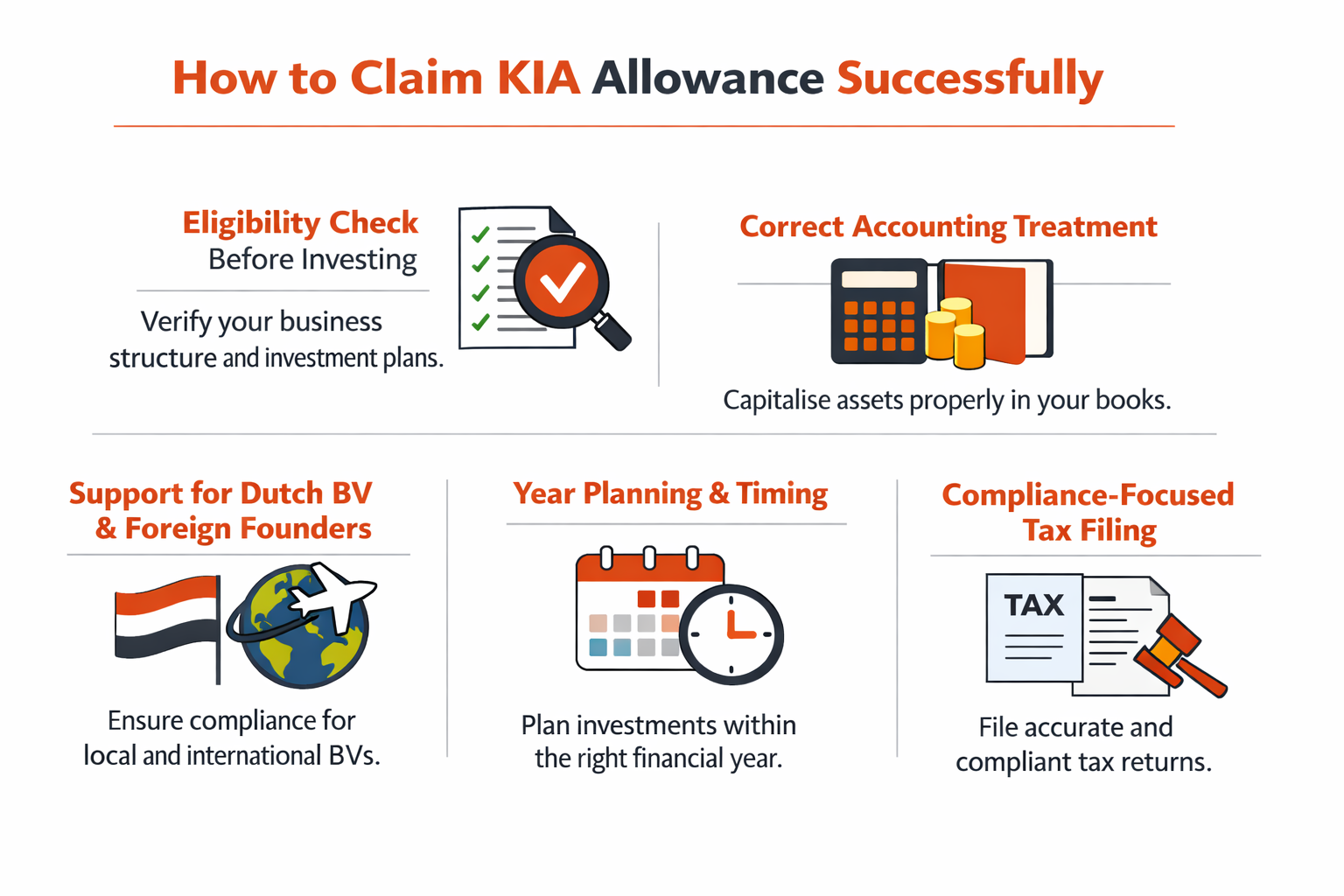
- Eligibility check before investing
We review whether your business structure, tax position, and planned asset are likely to qualify. This avoids investing in assets that later turn out to be excluded. - Correct accounting treatment
Many KIA issues come from assets being expensed instead of capitalised, or recorded incorrectly. We make sure investments are booked in line with Dutch tax rules. - Support for Dutch BV and foreign founders
For foreign-owned BVs, we check whether the investment clearly belongs to the Dutch entity and supports real business activity. This reduces questions during tax review. - Year planning and timing
We help businesses understand how investment timing affects KIA eligibility, without pushing unnecessary or artificial purchases. - Compliance-focused tax filing
KIA is included correctly in the income tax or corporate tax return, with supporting documentation ready if questions arise later.
Our approach is simple: no shortcuts, no aggressive claims, no surprises later. KIA should support real business growth, not create future tax risk.
When KIA is handled properly, it becomes a useful part of a broader tax strategy. When it is handled casually, it often leads to corrections. Our role is to make sure you stay on the first path, not the second.


Ready to Launch
Your

Dutch Business
Dutch
Business
FirmNL specializes in helping foreign entrepreneurs establish a presence across the EU. From Dutch BV incorporation to tax compliance, sales outsourcing and EU fulfillment — we provide solutions tailored to your goals.