Dutch Legal Entities and Accounting Standards: What Founders Must Know
4 Min
February 9, 2026
Author:
Garry
.png)
When founders plan to start or expand a business in the Netherlands, most focus first on company registration. That makes sense. But very soon, accounting standards and legal entity rules start to matter even more. We see this every week at FirmNL. Founders choose a Dutch legal entity, but they are not always clear about the accounting rules that come with it.
In the Netherlands, accounting is not optional or flexible. Each legal entity type follows specific Dutch accounting standards. These rules decide how you maintain books, what reports you must file, and how transparent your business looks to tax authorities, banks, and partners. Missing this early creates problems later.
Many international founders assume accounting will be similar to their home country. In reality, Dutch accounting standards work differently, especially for micro and small legal entities. Even cooperative structures follow their own reporting logic. This is where confusion usually starts.
At FirmNL, we explain these topics in a simple way, without legal language. In this article, we walk you through Dutch legal entities and the accounting standards that apply to them. So you know what founders must know before mistakes happen.
Overview of Dutch Legal Entities Commonly Used by Founders
For founders entering the Netherlands, choosing the right Dutch legal entity is one of the first and most important steps. This decision affects not just liability and ownership, but also accounting standards and reporting obligations.
Most international founders incorporate a Dutch BV (Besloten Vennootschap) because it offers limited liability, clear Dutch accounting standards, and strong acceptance by banks and tax authorities. Micro and small BVs follow specific reporting rules under Dutch accounting law.
Some founders also opt for a Dutch cooperative legal entity, especially for group structures, platforms, or joint ventures. Understanding the different types of legal entities in the Netherlands can help founders choose the structure that fits their business. Cooperatives have their own accounting and reporting requirements, which depend on size and activity.
What Are Dutch Accounting Standards and Who Must Follow Them
Dutch accounting standards define how businesses in the Netherlands must keep records, prepare financial statements, and report results. These rules apply to all Dutch legal entities, no matter if the company is active or not. Many founders think accounting starts only when revenue comes in, but in the Netherlands, compliance starts from day one.
The standards are mainly based on Dutch civil law and are different for micro, small, and larger legal entities. A micro Dutch BV does not report the same way as a small BV. The same logic applies to cooperative legal entities as well. Size matters here, not just the entity type.
Every Dutch company must prepare annual accounts in Netherlands and file them with the authorities. Even if the business has no transactions, reporting is still required. This is where many foreign founders get surprised later.
Dutch Accounting Standards for Micro Legal Entities
In the Netherlands, micro legal entities have simpler accounting rules, but that does not mean accounting can be skipped. Many founders think “micro company” means no compliance. That is not true. Rules are easier, yes, but they still apply.
A Dutch BV is treated as a micro legal entity when it stays under certain limits:
- Low annual turnover
- Small balance sheet value
- Very few employees
When a company falls under this category, Dutch law allows shorter financial statements and less public disclosure. This is one reason many founders prefer starting as a micro BV.
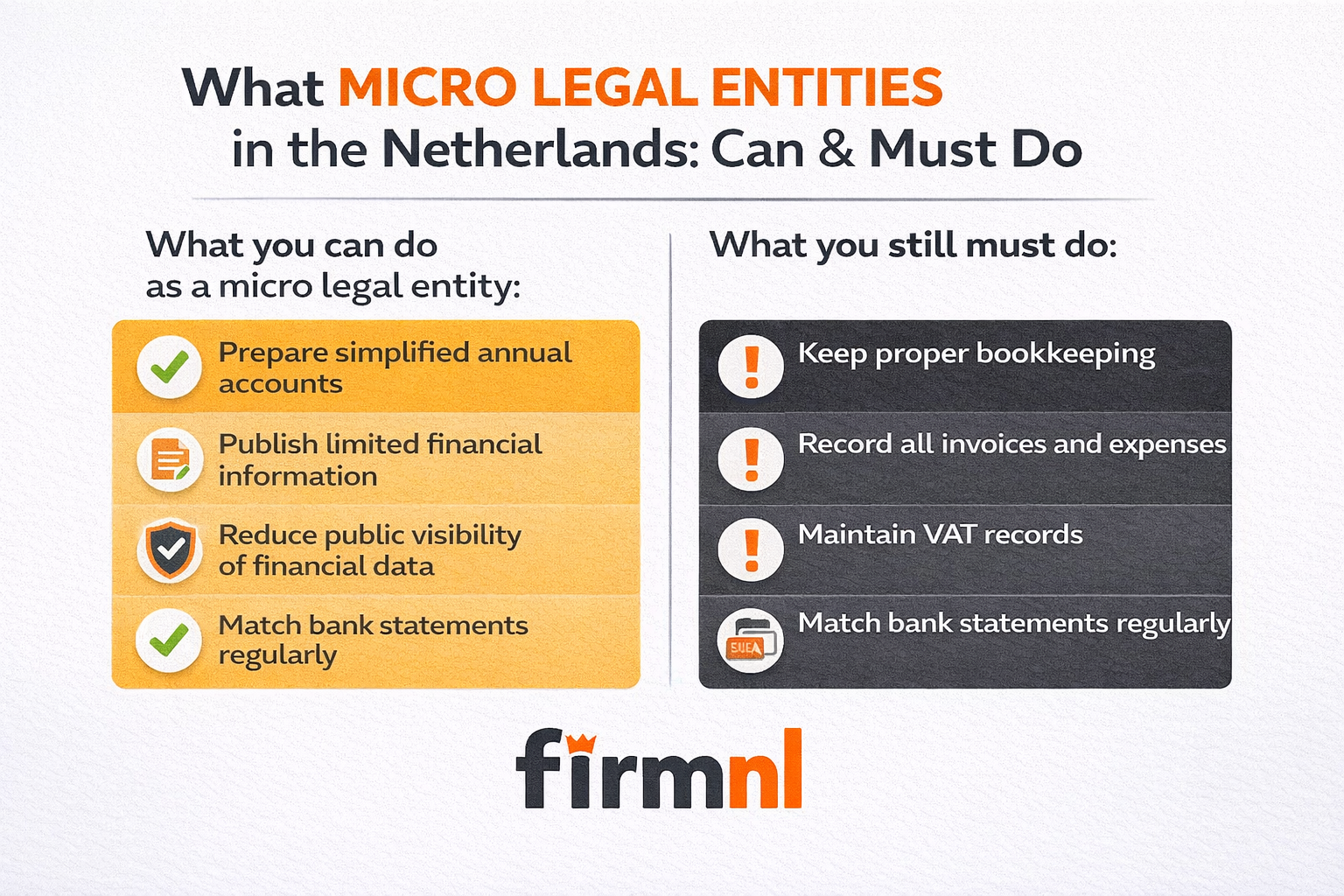
What you can do as a micro legal entity:
- Prepare simplified annual accounts
- Publish limited financial information
Reduce public visibility of financial data
What you still must do:
- Keep proper bookkeeping
- Record all invoices and expenses
- Maintain VAT records
Match bank statements regularly
Even if reports look small, tax authorities can ask for full details anytime. This surprises many foreign founders later.
Dutch Cooperative Legal Entity and Its Accounting Requirements
A Dutch cooperative legal entity is often chosen when multiple parties operate together, such as platforms, joint ventures, or group-based business models. While it offers flexibility in structure, founders should not assume accounting is flexible too. Dutch accounting standards still apply fully.
- A Dutch cooperative legal entity must follow Dutch accounting standards, just like a BV.
- Bookkeeping is mandatory from day one, even if the cooperative has limited activity.
- Annual financial statements must be prepared and filed on time.
- Reporting level depends on size (micro or small), not only on the cooperative structure.
- Member contributions, distributions, and internal transactions must be recorded clearly.
- Poor accounting setup in cooperatives often creates issues during tax checks or audits.
Reporting, Filing, and Compliance Obligations Across Dutch Legal Entities
No matter which Dutch legal entity a founder chooses, reporting and filing obligations apply across the board. This is something we repeat often at FirmNL. Legal Entity type may change, size may change, but compliance is never optional.
All Dutch legal entities must prepare annual financial statements and file them within the required deadlines. These filings go to the Dutch Chamber of Commerce. Even inactive companies must file. Skipping this leads to penalties and sometimes director liability issues.
Apart from annual accounts, companies must also stay compliant with tax filings. This includes corporate income tax returns and, where applicable, VAT returns. The frequency and complexity depend on business activity and entity size, but the obligation remains the same.
Deadlines are strict in the Netherlands. Late filing is one of the most common issues we see with foreign founders. Most of the time, it happens because accounting was not set up properly from the start.
We manage reporting calendars, filings, and reminders for founders, so nothing slips through. This keeps businesses compliant and stress-free year after year.
When Micro and Small Dutch Legal Entities Should Upgrade Their Accounting Setup
Many founders start with a basic accounting setup, which is fine in the early stage. The problem starts when the business grows but the accounting system stays the same. We see this situation very often.
You should upgrade your accounting when turnover increases, transactions become frequent, or the company moves from micro to small legal entity status. Hiring staff, adding EU VAT registrations, or working with multiple countries are also clear signals.
Delaying this upgrade usually leads to messy books, late filings, and higher correction costs later. Fixing accounting after mistakes is always harder than setting it up right early.
At FirmNL, we help founders upgrade their accounting step by step, without disrupting daily operations. The idea is simple: accounting should support growth, not slow it down.
We support founders from the very beginning. That includes choosing the right Dutch legal entity, Setting up compliant bookkeeping and providing ongoing accounting and bookkeeping services in the Netherlands. Whether your company qualifies as micro, small, or operates as a cooperative legal entity, we align accounting with Dutch standards from day one.
Our team manages annual accounts, tax filings, VAT compliance, and deadline tracking. Founders don’t need to chase accountants or worry about missing filings. Everything stays organized and transparent.
Most importantly, we work like a local partner, not a document processor. We explain things clearly, flag issues early, and adjust accounting as your business grows. This is how we help founders operate confidently in the Netherlands, year after year.



Ready to Launch
Your

Dutch Business
Dutch
Business
FirmNL specializes in helping foreign entrepreneurs establish a presence across the EU. From Dutch BV incorporation to tax compliance, sales outsourcing and EU fulfillment — we provide solutions tailored to your goals.