How to Hire Employees in the Netherlands with Foreign Entity?
4 Min
March 24, 2026
Author:
Garry
.png)
When international founders start entering the European market, one of the first practical questions we hear is simple — can we hire someone in the Netherlands without setting up a full Dutch company?
In many cases, the answer is yes. But the way you do it matters a lot.
We have seen businesses rush into hiring, thinking it is just about sending an offer letter and paying a salary. In reality, the Netherlands has a structured employment system. Payroll taxes, employee rights, social security, and compliance obligations are tightly regulated.
So if you get the structure wrong in the beginning, fixing it later becomes expensive and sometimes risky.
In this article, we will walk you through how hiring actually works when you don’t yet have a Dutch entity, what options are available, and what approach makes the most sense depending on your stage.
Can a Foreign Company Hire Employees in the Netherlands?
Yes, a foreign company can hire employees in the Netherlands. But let me explain this the way we usually explain it to founders on a call, because this is where most people misunderstand the situation.
A few months back, we worked with a US-based SaaS company. They wanted to hire their first sales manager in Amsterdam. From their perspective, it felt simple — find the candidate, send an offer, and start paying salary from their US entity.
On paper, that sounds fine. But the moment we looked deeper, a few things became clear.
They didn’t have:
- a Dutch payroll system
- a wage tax number (loonheffingennummer)
- registration with Dutch social security
And this is where reality kicks in.
In the Netherlands, salary is not just “transfer money to employee.” Every payment must go through a compliant payroll process where:
- income tax is deducted correctly
- social contributions are handled
- employment laws are respected
- reporting is done to Dutch authorities
Without this setup, even if you pay the employee, it is not considered a compliant employment structure. So coming back to your question — can a foreign company hire employees?
Yes, legally possible. But not directly in a casual way.
You need a structure in place before the first salary is paid.
In that SaaS company’s case, we had two options:
- either quickly onboard through an Employer of Record to start hiring immediately
- or take a slightly longer route and set up a Dutch BV so they could hire directly
They initially thought skipping structure would save time. In reality, it would have created tax exposure and compliance risk within a few months. This is why we always say: Hiring in the Netherlands is not blocked for foreign companies. But it is regulated, and the system expects you to follow a defined route. So the correct way to think about it is not “Can we hire?” It is “How do we hire in a way that is compliant from day one?”
Read More: How to Start a Business in the Netherlands as a Foreigner?
The Main Ways to Hire in the Netherlands Without a Dutch Entity
There are a few commonly used models. Each one works, but each comes with its own level of control, cost, and compliance responsibility.
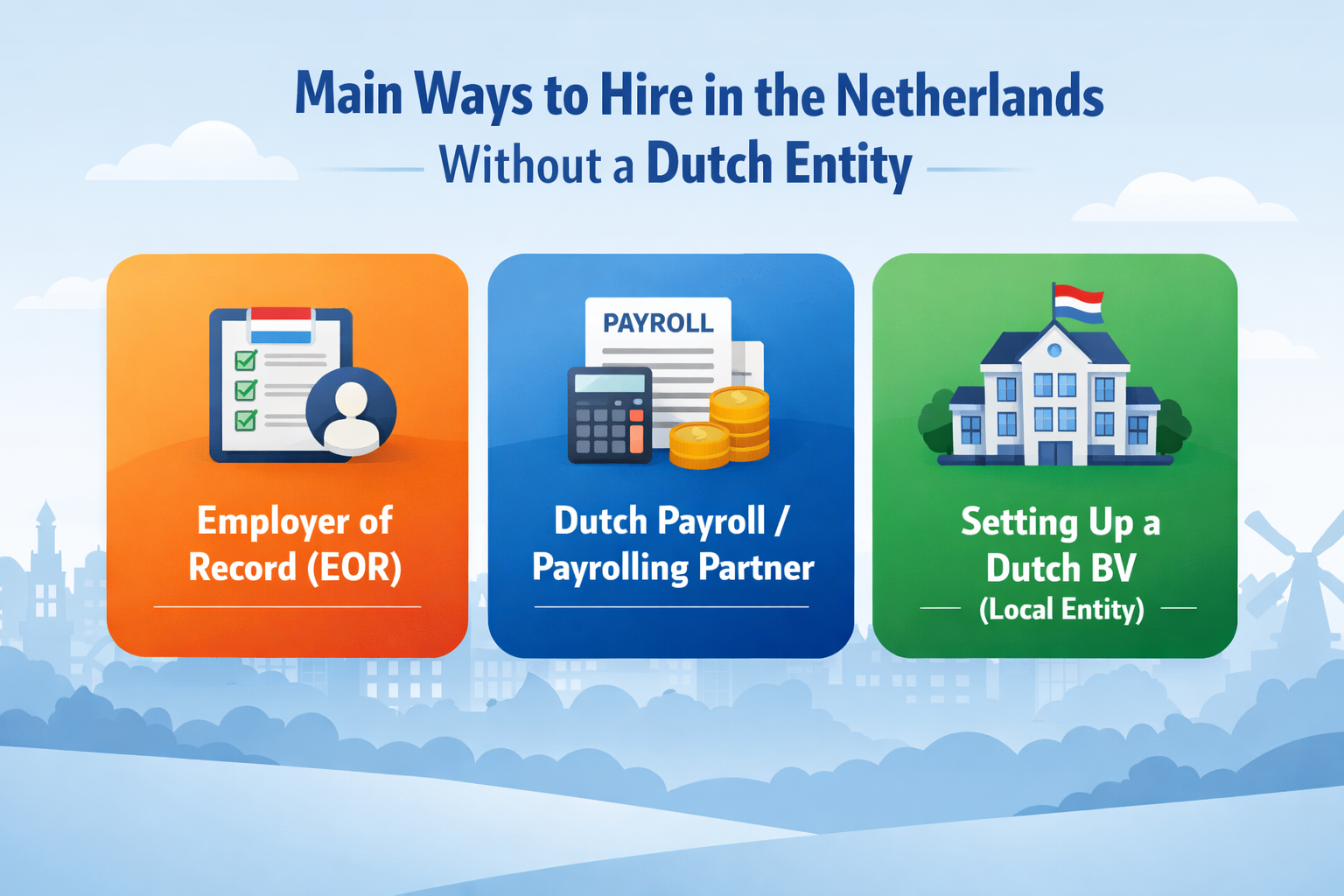
1. Employer of Record (EOR)
This is usually the fastest way to hire your first employee in the Netherlands.
In this model:
- A local Dutch company becomes the legal employer
- Your employee works for you operationally
- The EOR handles payroll, taxes, and compliance
From our experience, this works best when you are testing the market or hiring 1–3 employees. However, it comes with a recurring service cost, which becomes expensive as your team grows.
2. Dutch Payroll / Payrolling Partner
This is slightly different from EOR, but the concept is similar.
A Dutch payroll provider:
- manages salary processing
- ensures tax compliance
- handles employment administration
The difference is that in some structures, you still retain more operational involvement compared to a full EOR model.
This works well when you already have some presence or plan to scale soon.
Also Checkout: Netherlands Payroll Tax Relief: Understanding the Severance Withholding Tax Waiver
3. Setting Up a Dutch BV (Local Entity)
If you are serious about long-term operations, this is usually the most stable approach.
With a Dutch BV setup:
- you become a registered employer
- you run your own payroll
- you have full control over hiring
It requires more effort at the start, but over time, it becomes more cost-efficient and gives you better operational flexibility.
4. Hiring as Independent Contractors (Not Recommended in Most Cases)
Many companies try this first because it looks simple.
But in the Netherlands, contractor classification is taken very seriously.
If your “contractor”:
- works fixed hours
- follows your internal structure
- depends on you as primary income
Then legally, they may be considered an employee. And that creates backdated tax liabilities and compliance issues. We usually advise clients to avoid this unless the structure is genuinely independent.
When a Foreign Entity Can Hire Directly, and When It Should Not
This is where most confusion happens.
On paper, a foreign entity can hire directly. But in practice, it only works if you are ready to handle Dutch employer obligations.
Let’s break it down in a simple way:
If you plan to:
- hire multiple employees
- run long-term operations
- build a sales or operational team
Then direct hiring without a Dutch structure becomes difficult to manage.
On the other hand, if:
- you are testing the market
- hiring one employee
- or setting up gradually
Then using an EOR or payroll partner is usually the safer starting point.
Employer of Record vs Dutch BV Setup: Which One Makes More Sense?
Instead of overcomplicating this, we usually explain it to founders in a simple comparison.
If you are hiring your first employee, EOR is usually practical. If you are building a team, setting up a Dutch BV becomes the smarter move.
Legal and Payroll Obligations You Still Need to Handle
Even if you are using a partner model, there are responsibilities you cannot ignore.
Employment in the Netherlands comes with structured obligations.
You need to ensure:
- proper employment contracts
- compliance with Dutch labor law
- wage tax deductions
- social security contributions
- employee benefits and protections
Employees in the Netherlands are well protected, and mistakes here are not treated lightly. This is why having the right structure from day one is important.
The Risk of Misclassifying Contractors in the Netherlands
We have seen multiple foreign companies make this mistake.
They hire someone as a freelancer to avoid payroll complexity.
But later:
- the individual works like a full-time employee
- follows company rules
- depends entirely on that one company
At that point, Dutch authorities can reclassify the relationship.
This means:
- unpaid payroll taxes
- penalties
- legal complications
So what looks like a shortcut often becomes a bigger problem.
What Foreign Employers Need Before Hiring Their First Employee
Before hiring your first employee in the Netherlands, you need more than just a candidate—you need clarity on structure. From how payroll will be handled to who manages compliance, every piece must be defined in advance. We have seen businesses move fast on hiring but slow on setup, and that’s where issues begin.
You should already have clarity on:
- how payroll will be handled
- which hiring model you will use
- who will manage compliance
- how contracts will be structured
- how employee taxes will be processed
From our experience, once this foundation is clear, hiring becomes smooth. Without it, even a simple offer letter can turn into a compliance problem within weeks.
How FirmNL Supports Foreign Companies Hiring in the Netherlands
In most cases, hiring is not just an HR decision. It’s a combination of legal, tax, and operational setup.
We typically help businesses with:
- setting up a Dutch BV for long-term hiring
- connecting with payroll and EOR partners
- handling accounting and bookkeeping
- managing VAT and EORI registrations
- ensuring compliance from day one
The goal is simple — make sure your hiring setup does not slow down your growth later.
Final Thoughts
Hiring in the Netherlands without a local entity is definitely possible—but from what we’ve seen, the real difference comes down to how you structure it from day one.
We’ve worked with companies who made the right call early—started with an EOR, then moved to a Dutch BV at the right time—and their expansion felt smooth, almost predictable. On the other hand, we’ve also seen businesses try to skip structure, hire quickly, and then spend months fixing payroll, tax, and compliance issues later.
If you’re planning to hire here, don’t rush the first step.
Take a moment to evaluate where your business stands today—are you testing the market, or building a long-term team?
Start simple if needed, but make sure the foundation you choose today can support where you want to go next.
FAQs
Can a foreign company hire employees in the Netherlands?
Yes, but it must follow a structured approach such as Employer of Record, payroll partner, or local entity setup.
Do I need a Dutch BV to hire employees?
Not always. But if you plan to build a team, having a Dutch BV becomes more practical.
What is the easiest way to hire in the Netherlands?
Employer of Record is usually the easiest and fastest way to start.
Is hiring freelancers a good alternative?
Only if the relationship is genuinely independent. Otherwise, it can create compliance risks.
What is the safest long-term hiring approach?
Setting up a Dutch BV and managing your own payroll system.


Ready to Launch
Your

Dutch Business
Dutch
Business
FirmNL specializes in helping foreign entrepreneurs establish a presence across the EU. From Dutch BV incorporation to tax compliance, sales outsourcing and EU fulfillment — we provide solutions tailored to your goals.