How to Create a Holding Company in the Netherlands?
4 Min
December 23, 2025
Author:
Garry

At FirmNL, we explain this in the simplest way. A holding company in the Netherlands is usually a Dutch BV that owns shares in one or more other companies, called operating companies. The holding itself does not run day-to-day business activities. Instead, it sits on top of the structure and holds value. This value can be shares, profits, intellectual property, or long-term investments. The actual business operations, customers, contracts, and risks stay inside the operating company. Together, the holding company and its operating companies form what we call a holding structure. We see international founders use this setup to separate risk, protect profits, and plan growth in a cleaner and more controlled way.
Do You Really Need a Holding Company?
We often explain founders that a holding company is useful, but not always mandatory. You usually need a Dutch holding company if you plan to run multiple businesses, raise investments, hold shares long term, or protect profits outside daily business risk. It also makes sense if you want to reinvest profits, own intellectual property separately, or prepare for future exits. However, we also see many founders create a holding too early, which increases costs and compliance without practical benefit. If you are running a single business with no investors and no expansion plan yet, a simple operating BV is often enough. This is why we always assess your situation first and recommend a holding structure only when it adds real value.
You usually need a holding company if you plan to:
- Run multiple businesses under one group
- Hold shares or investments long term
- Protect profits from daily business risks
- Prepare for fundraising or a future exit
In all the above cases, a holding structure adds real value.
However, if you are running one business, have no investors, and no short-term expansion plans, a simple operating BV is often enough. Creating a holding too early only increases setup cost, bookkeeping, and tax compliance.
This is whyFirmNL always review your business plan first. We recommend a Dutch holding company only when it actually supports your growth, not just because it sounds “advanced”. And yes, the final decision is taken by client only.
Why the Netherlands Is a Popular Jurisdiction for Holding Companies
Netherlands has become one of the trusted locations for setting up holding companies, especially for international founders. FirmNL works with clients from US, UK, Asia, and the Middle East who choose the Netherlands for one simple reason: clarity and predictability.
One of the biggest reason is the participation exemption. In simple terms, this allows a Dutch holding company to receive dividend and capital gains from its subsidiaries without paying tax again in the Netherlands, as long as basic conditions are met. This is a major advantage for group structures and long-term investments.
Another strong factor is the Netherlands’ double tax treaty network. With treaties in place with many countries, it becomes easier to avoid double taxation when profits move across borders. This is why the Netherlands is often preferred over more aggressive or unclear jurisdictions.
On top of that, a Dutch holding company has a strong international reputation. Banks, investors, and partners are comfortable dealing with Dutch entities. This reduces friction when opening bank accounts, raising funds, or expanding into other EU markets.
This combination of tax efficiency, legal stability, and global trust is what makes the Netherlands a natural choice for holding companies.
Founders comparing structures can also review the different Dutch legal entities available before deciding how the holding and operating companies should be organized.
Best Legal Structure for a Dutch Holding Company
In practice, most Dutch holding companies are set up as a private limited company (BV). We recommend it in the majority of cases because it is flexible, widely accepted, and easy to manage for international founders.
A Dutch BV works well as a holding company because:
- There is no minimum capital requirement in real terms
- Shareholders and directors can be non-residents
- It supports dividend payments and group structures smoothly
- Banks and investors are already familiar with it
Other structures like cooperatives or STAK setups are sometimes used, but only in specific situations. For example if cooperatives are mainly relevant for very large groups or EU-focused dividend flows and STAK structures are mostly used for asset protection or separating voting rights. These are not default options and are rarely needed for standard international holding setups.
This is why a Dutch BV incorporation is usually the starting point for a standard holding structure, while alternative structures are considered only when there is a clear legal or tax reason. Keeping the structure simple from day one avoids unnecessary costs and compliance issues later.
How a Dutch Holding Structure Works in Practice
A Dutch holding structure is usually simple. The holding company sits at the top, and one or more operating companies sit below it. At FirmNL, this is the most common setup we implement for international founders.
The operating company is where all real business activity happens. This includes sales, contracts, employees, customers, and daily risks. The holding company does not deal with customers or operations. Its role is to own shares, receive profits, and hold valuable assets.
When the operating company makes a profit, it can distribute dividends to the holding company. In most cases, this can be done without additional tax in the Netherlands because of the participation exemption. The profits can then stay inside the holding company and be reinvested, used for new ventures, or held safely outside operational risk.
This structure also helps with risk separation. If something goes wrong in the operating company, the assets and accumulated profits held at the holding level are protected. This is one of the main reasons founders use a holding structure instead of running everything through a single BV.
Step-by-Step – How to Create a Holding Company in the Netherlands
Creating a Dutch holding company follows a clear order, and getting this order right is important. At FirmNL, we always start with the holding company first, and only then set up the operating company underneath it.
The first step is incorporating the holding BV through a Dutch notary. This includes pparing the Articles of Association, completing the Netherlands company registration process with the Dutch Chamber of Commerce (KVK), and completing UBO and KYC checks. Once the holding BV is registered, it becomes the shareholder of the operating company.
After that, the operating company is incorporated, again through a notary, but this time the holding company owns the shares, not you personally. This creates the correct legal and tax structure from day one.
Next comes tax registration. The companies are registered for corporate tax, and VAT is added if the operating company performs taxable activities. Banking is handled in parallel, which is often the most time-consuming part for foreign founders.
Most importantly, this entire process does not require you to travel to the Netherlands. We handle the incorporation, coordination with notaries, tax registration, and compliance setup remotely, so you can focus on your business while we take care of the structure.
Summary of the Process:
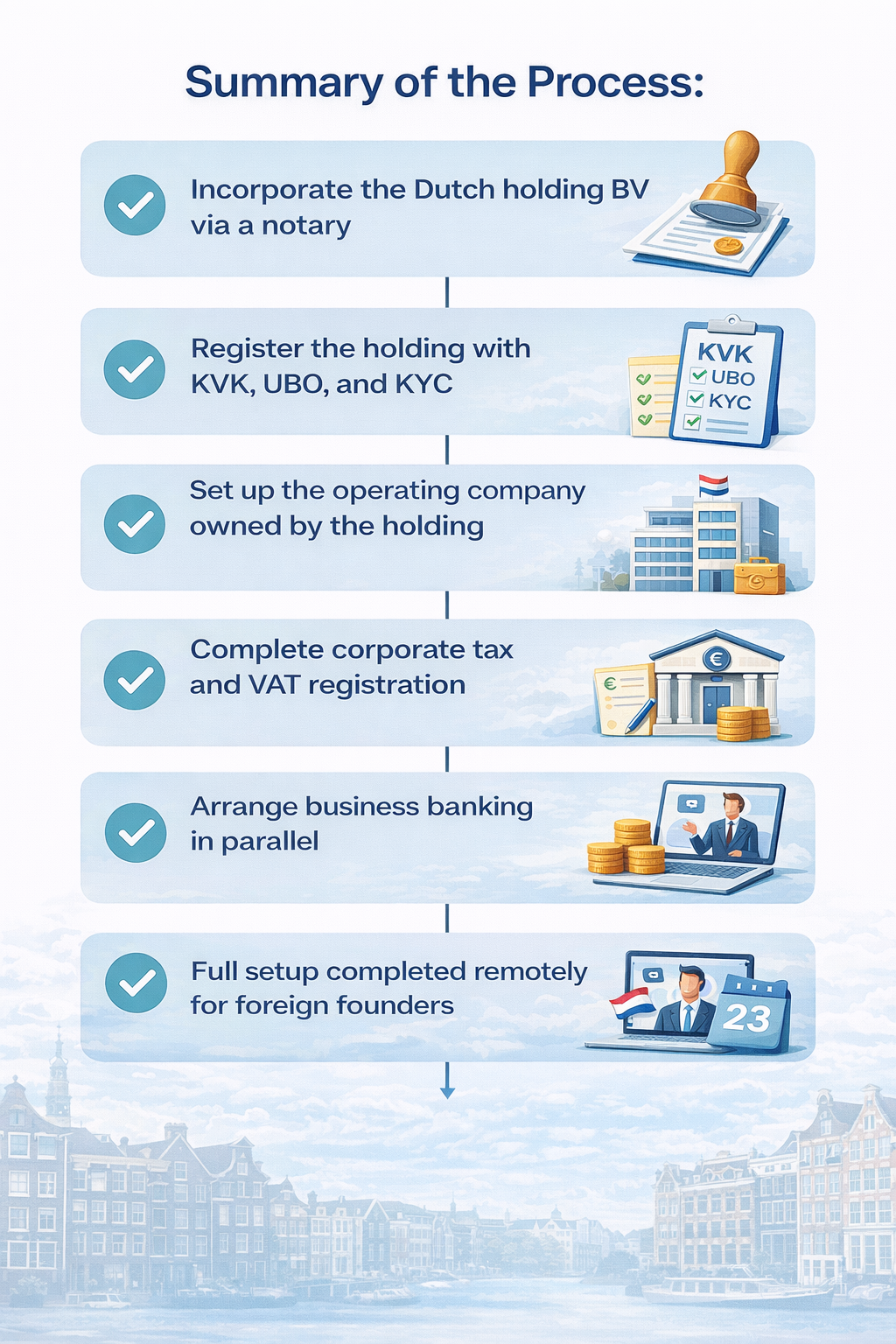
- Incorporate the Dutch holding BV via a notary
- Register the holding with KVK, UBO, and KYC
- Set up the operating company owned by the holding
- Complete corporate tax and VAT registration
- Arrange business banking in parallel
- Full setup completed remotely for foreign founders
Tax and Substance Rules You Must Understand
This is where many founders get confused, so at FirmNL we keep it practical and clear.
A Dutch holding company pays corporate tax on its own income, but in most group structures the key benefit comes from the participation exemption. When the holding owns at least a qualifying stake in its operating company, dividends and capital gains received from that subsidiary are usually not taxed again in the Netherlands. This is one of the main reasons founders use a holding structure.
Substance is another topic that often causes unnecessary worry. Substance requirements mainly matter when you want to access tax treaties or EU directives. If your holding is simply owning shares and receiving dividends, full substance is not always required. However, when cross-border payments, treaty benefits, or complex tax planning are involved, some level of Dutch substance becomes important.
In real life, substance can include things like local decision-making, proper administration, and real economic presence. What matters is not overdoing it. Over-engineering substance increases cost without adding value. Under-doing it creates compliance risk.
This is exactly why we guide founders case by case. We make sure your holding company meets the right level of substance, no more and no less, so it stays compliant and efficient.
For founders who are still evaluating the incorporation process, this guide to Dutch BV set-up explains the main steps involved in establishing the structure.
How FirmNL Helps You Set Up and Manage a Dutch Holding Company
We do more than just register holding companies. We act as your local partner in the Netherlands, making sure your holding structure works not only on paper, but also in real life.
We handle the complete setup of your Dutch holding and operating company, including notary coordination, KVK registration, tax registration, and compliance onboarding. For international founders, we also support remote incorporation, so you don’t need to travel or deal with multiple parties on your own.
Beyond setup, we stay involved. We manage ongoing accounting & bookkeeping, and tax compliance, and help you with banking, dividend planning, and structural decisions as your business grows. When substance is required, we guide you on what is genuinely needed and help you implement it in a cost-effective way.
Most importantly, we simplify decisions. Instead of pushing complex structures, we focus on what actually fits your business goals. That is why founders choose FirmNL not just to create a Dutch holding company, but to run it confidently and compliantly over the long term.



Ready to Launch
Your

Dutch Business
Dutch
Business
FirmNL specializes in helping foreign entrepreneurs establish a presence across the EU. From Dutch BV incorporation to tax compliance, sales outsourcing and EU fulfillment — we provide solutions tailored to your goals.