Netherlands vs France vs Belgium: Best Country to Start a Business
4 Min
August 21, 2026
Author:
Garry
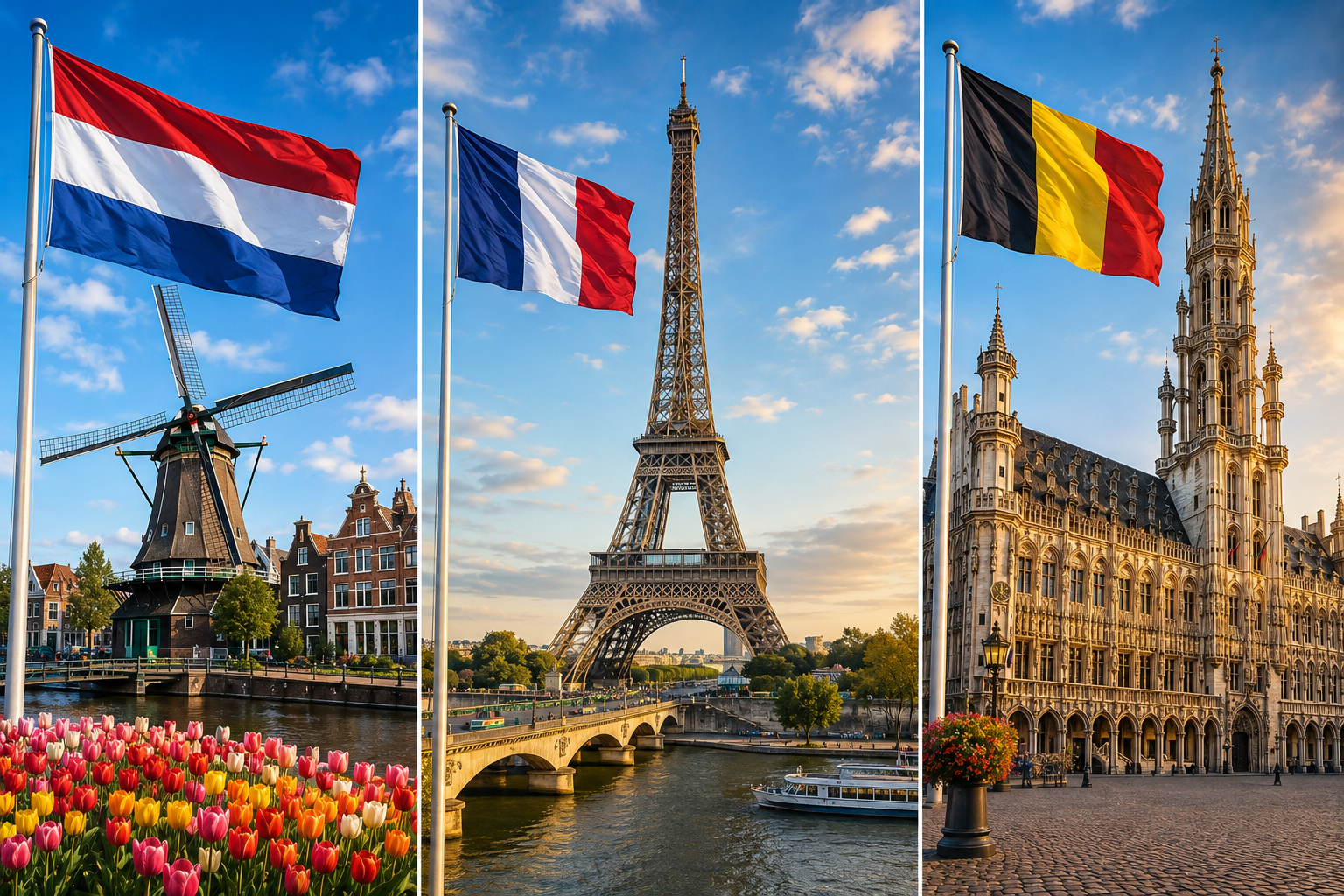
Founders looking to expand into Western Europe will face a traditional tri-junction of countries: the Netherlands, France, and Belgium. Being geographically contiguous to each other, these three countries are worlds apart in terms of their respective business environments. Careful analysis must be done, beyond the superficial similarities, in order to determine which jurisdiction to enter.
We break down structural mechanics, examine core business vehicles like the Dutch BV, the French SARL (or SAS), and the Belgian SRL, and analyze the distinct Netherlands vs France vs Belgium business environments to position ventures correctly. Savvy executives evaluate Netherlands vs France comparisons before executing cross-border transitions. Analyzing Belgium vs Netherlands frameworks clarifies which jurisdiction minimizes operational friction. Reviewing the BV vs SARL vs SRL comparison ensures founders select the optimal legal vehicle for long-term growth.
The Strategic Landscape: Core Economic Profiles
Each nation appeals to a distinct operational model. Understanding national economic priorities prevents costly strategic mismatches.
The Netherlands acts as the best commercial gateway to Europe for international founders entering the Netherlands. Amsterdam and Rotterdam serve as the base of a country built on the principles of international business, logistics, and e-commerce. The employees have almost full proficiency in English. The regulatory bodies focus on commercial effectiveness. Businesses pick the Netherlands jurisdiction to optimize their international supply chain operations, form a holding company, or create high-growth tech startups.
France provides not only an immense domestic consumer market but also strong innovation incentives from the government. Paris is one of the major European centers of venture capital and deep-tech research. The government attracts foreign founders through special tech visas and well-structured R&D credits. Businesses select France to gain significant domestic market share, use the engineering skills of France, or establish their European production facilities.
Belgium is situated at the very center of the administration of the European Union. Being located in Brussels ensures unparalleled access to the regulatory agencies of Europe. Businesses create consulting firms and foreign service providers in Belgium. Belgian jurisdiction attracts companies that are looking for a stable legal and institutional environment and geographical centrality.
Legal Vehicles Compared: BV vs SARL/SAS vs SRL
Structuring a venture requires choosing the correct legal entity in the Netherlands or an equivalent private limited liability vehicle in France or Belgium. All three countries offer limited liability to protect personal assets. Internal governance rules and setup requirements diverge sharply.
The Dutch Besloten Vennootschap (BV)
The Dutch BV sets the gold standard for flexible corporate governance. Founders incorporate with a nominal starting capital of just €0.01. Shares carry customizable voting and profit rights. Founders balance control and investor participation effortlessly. The setup requires a mandatory deed executed before a Dutch civil-law notary. Non-resident founders complete the process remotely, assuming identity verification standards are clear. Timelines span one to three weeks.
The French SARL and SAS Vehicles
France offers two primary private vehicles. The SAS surpasses the traditional SARL for venture-backed startups due to contract-heavy flexibility. Nominal minimum capital starts at €1, though higher amounts build credibility in traditional sectors. The SAS provides ultra-flexible governance resembling Anglo-American corporate structures. The SARL enforces stricter statutory controls over share transfers and management liability. The setup involves drafting statutes, depositing share capital into a blocked bank account or notary escrow, publishing a legal notice, and registering through the Corporate Formalities Window (Guichet Unique).
The Modern Belgian Société à Responsabilité Limitée (SRL)
Belgium reformed its company code entirely to eliminate rigid capital rules. The modern SRL (or BV in Dutch-speaking Flanders) replaces the old Société Privée à Responsabilité Limitée (SPRL). Statutory minimum capital requirements do not exist. Founders prove adequate initial capitalization through a rigorous financial plan. Insolvency within three years under an unrealistic plan triggers personal founder liability. Voting arrangements remain flexible while adhering strictly to Belgian corporate law codes. Registration occurs via the Crossroads Bank for Enterprises.
Tax Frameworks and Financial Incentives
Tax strategy dictates the final choice between these three competing European jurisdictions, especially when comparing Dutch capital gains tax and other local tax rules.
French Corporate Taxation and Innovation Credits
France maintains a standard corporate tax flat rate at 25%. France deploys the Crédit d'Impôt Recherche (CIR). This tax credit targets eligible research and development expenditure, rewarding tech and engineering enterprises. Competitive corporate rates contrast with payroll taxes and social security contributions levied on employers, ranking among the highest in Europe.’
Dutch Tax System and Holding Benefits
The Netherlands imposes corporation tax in the following brackets: 19% for taxable profits not exceeding €200,000, while any taxable profits exceeding this amount will be taxed at 25.8%. The Dutch Participation Exemption law ensures that dividends and capital gains earned from subsidiaries are exempt from taxation, making **BV** one of the most sought-after holding vehicles. The 30% ruling exempts foreign recruited staff from paying taxes.
Belgian Fiscal Regimes and Employment Costs
Belgium hits a standard corporate tax flat rate of 25%, with reduced brackets available for qualifying small businesses under strict profit conditions. Belgium provides specialized tax boxes allowing qualifying net income from patents and copyrighted software to face heavily reduced effective rates. Employing staff in Belgium incurs heavy mandatory employer social security contributions exceeding 50% on top of base gross salaries.
Operational Realities: Employment and Labor Law
Founders expanding operations across borders experience friction around labor laws and may need to understand how to hire employees in Europe. Employment compliance diverges drastically between these nations.
The Netherlands balances professional flexibility with strong employee protection. Dismissal procedures require approval via the UWV or subdistrict court. Contractual terms allow performance-driven structures.
France functions according to tough labor laws (*Code du Travail*) and extensive collective labor agreements (*Conventions Collectives*). The process of terminating or restructuring is governed by statutory consultations.
Belgium is a heavily unionized country with tough industry-specific labor agreements. Year-end bonus payments, complicated indexations based on inflation, and high non-salary labor costs require thorough financial analysis prior to employing locals.
Powering Your European Market Entry With Firm NL
Expanding across borders demands a structured approach to cross-border regulations and EU market entry for foreign businesses. Navigating unfamiliar foreign jurisdictions without localized advisory expertise exposes leadership teams to administrative bottlenecks across the Netherlands vs France vs Belgium business landscape. Firm NL acts as your strategic partner, guiding international founders through European market entry. The advisory practice assumes full operational responsibility for regulatory filings from inception. Corporate structures comply strictly with local commercial law whether launching a Dutch BV, a French SARL, or a Belgian SRL. Firm NL manages digital filings, establishes registered office addresses, coordinates banking relationships, and mitigates regulatory risk. Partnering with Firm NL provides enterprises with a structured, compliant, and efficient pathway into Western European markets.
Conclusion
The choice of the best jurisdiction is purely based on business needs and goals. While the Netherlands is the most convenient place for efficient international trade and holding structures with the highest level of English spoken there in a predictable legal environment, France is the perfect place for having a big local consumer market, R&D tax credits, and an active tech and venture capital scene in Europe. Belgium is great for positioning businesses in central Europe and providing B2B service models in a stable environment.
FAQs
Which country offers the fastest and easiest remote company setup?
The Netherlands delivers the most streamlined remote incorporation process through a Dutch civil-law notary. Minimal starting capital requirements support the Dutch BV perfectly. Non-resident founders finalize documentation efficiently without requiring an immediate physical relocation or complex local presence.
How do corporate tax rates compare among the three nations?
The Netherlands utilizes tiered rates starting at 19%. France and Belgium enforce standard flat corporate tax rates of 25% while offering unique tax credits and incentives for innovation. Each fiscal framework impacts retained earnings and operational budgets differently depending on annual net revenue.
Is local residency required to register a company in France, Belgium, or the Netherlands?
Local residency remains optional for shareholders and directors across these three jurisdictions. Specific administrative procedures, local tax identification steps, and registered office requirements demand professional guidance to maintain total regulatory compliance.
Which corporate vehicle should tech startups choose?
Tech startups select the French SARL or SAS for venture-backed flexibility. Others choose the Dutch BV for holding structures depending on funding targets and equity strategies. Evaluating long-term capitalization needs ensures founders select the correct legal entity from inception.
How does Firm NL assist international founders during expansion?
Firm NL manages end-to-end regulatory compliance, digital filings, local registrations, and corporate structuring. Leadership teams focus entirely on scaling operations safely across Europe. Strategic advisory support eliminates administrative bottlenecks and prevents costly cross-border compliance errors.
What ongoing compliance duties apply to these European entities?
Companies file annual financial statements, manage corporate tax returns, and submit statutory updates regarding beneficial ownership changes. Staying current with local filing deadlines protects corporate standing and prevents heavy state penalties.
How do employment laws affect hiring local talent across these borders?
Employment compliance varies significantly, ranging from strict labor codes in France to unionized frameworks in Belgium. Understanding mandatory benefits and termination protocols protects organizations from unexpected labor disputes during team expansion.



Ready to Launch
Your

Dutch Business
Dutch
Business
FirmNL specializes in helping foreign entrepreneurs establish a presence across the EU. From Dutch BV incorporation to tax compliance, sales outsourcing and EU fulfillment — we provide solutions tailored to your goals.