How to Set Up a Dutch BV for Foreign Founders
4 minutes
October 9, 2023
Author:
FirmNL Team
We make it easy for foreign founders to incorporate remotely, secure limited liability, and stay fully compliant with Dutch regulations. FirmNL guides you from incorporation to VAT, banking, and operational setup.
For international entrepreneurs, setting up a Dutch BV is one of the most practical ways to establish a business presence in Europe. With this, they enjoy limited liability, access to the EU market, a trusted legal structure for customers and partners, and a solid foundation for long-term growth. Whether you’re launching a SaaS company, expanding an e-commerce business, or opening a European subsidiary, understanding the incorporation process is essential.
Keep in mind that setting up a Dutch BV involves more than filing incorporation documents. A founder must choose the right company structure, prepare the required documentation, register with the Dutch authorities, arrange tax registrations, open a business bank account, and meet ongoing compliance obligations. For foreign founders, missing even a single step or making an incorrect filing means delays in business expansion in Europe and additional costs.
At FirmNL, we see that many founders already know they need a Dutch BV, but they are unsure about setting up a BV in the Netherlands correctly without compliance mistakes. The process looks simple on the surface, yet small mistakes during incorporation, tax setup, or compliance can slow down operations later. This is why we focus not just on registration, but on building a BV that is ready to operate, invoice, and scale from day one.
In this guide, we explain how to set up a Dutch BV in a clear and practical way, based on how things actually work in the Netherlands — not theory. We also show where having a local partner like FirmNL makes a real difference in speed, compliance, and peace of mind.
What Is a Dutch BV and Why It Works for Foreign Founders
A Dutch BV (Besloten Vennootschap) is a private limited company under Dutch law. In simple terms, it separates your personal identity from your business. This means your liability stays limited to the company, not your personal assets. Most foreign founders apply for a Dutch BV (Besloten Vennootschap) as this structure brings more confidence to them both legally and commercially.
We often see foreign entrepreneurs compare different EU entities before deciding. If you are still evaluating whether the Netherlands is the right jurisdiction, our guide on starting a business in the Netherlands as a foreigner explains residency rules, legal options, and common challenges in more detail.
As a foreign entrepreneur, you can set it up with just one shareholder and one director, and both can live outside the Netherlands. Further, there is no legal requirement to be physically present, and no need to inject large capital upfront. Thus, making a Dutch BV a viable option for a foreign founder planning to expand in Europe remotely.
We have worked with multiple foreign founders and from our experience banks, payment providers, suppliers, and even marketplaces across Europe trust a Dutch BV more than many other structures. This signals to them that your business follows EU rules, Dutch compliance standards, and proper governance. That trust directly affects how easily you can open bank accounts, get VAT approvals, and start selling in the EU.
This is why we usually recommend a Dutch BV to foreign founders planning European expansion. Remember, this is not a legal formality for foreign businesses, but it gives a strong operational base for doing business in Europe.
Key Benefits of Choosing a Dutch BV for Foreign Founders
One of the biggest benefits of a Dutch BV for foreign founders is that it removes the friction at every stage for doing business in Europe. Here are the key benefits of choosing a Dutch BV for foreign founders that matter in real operations:
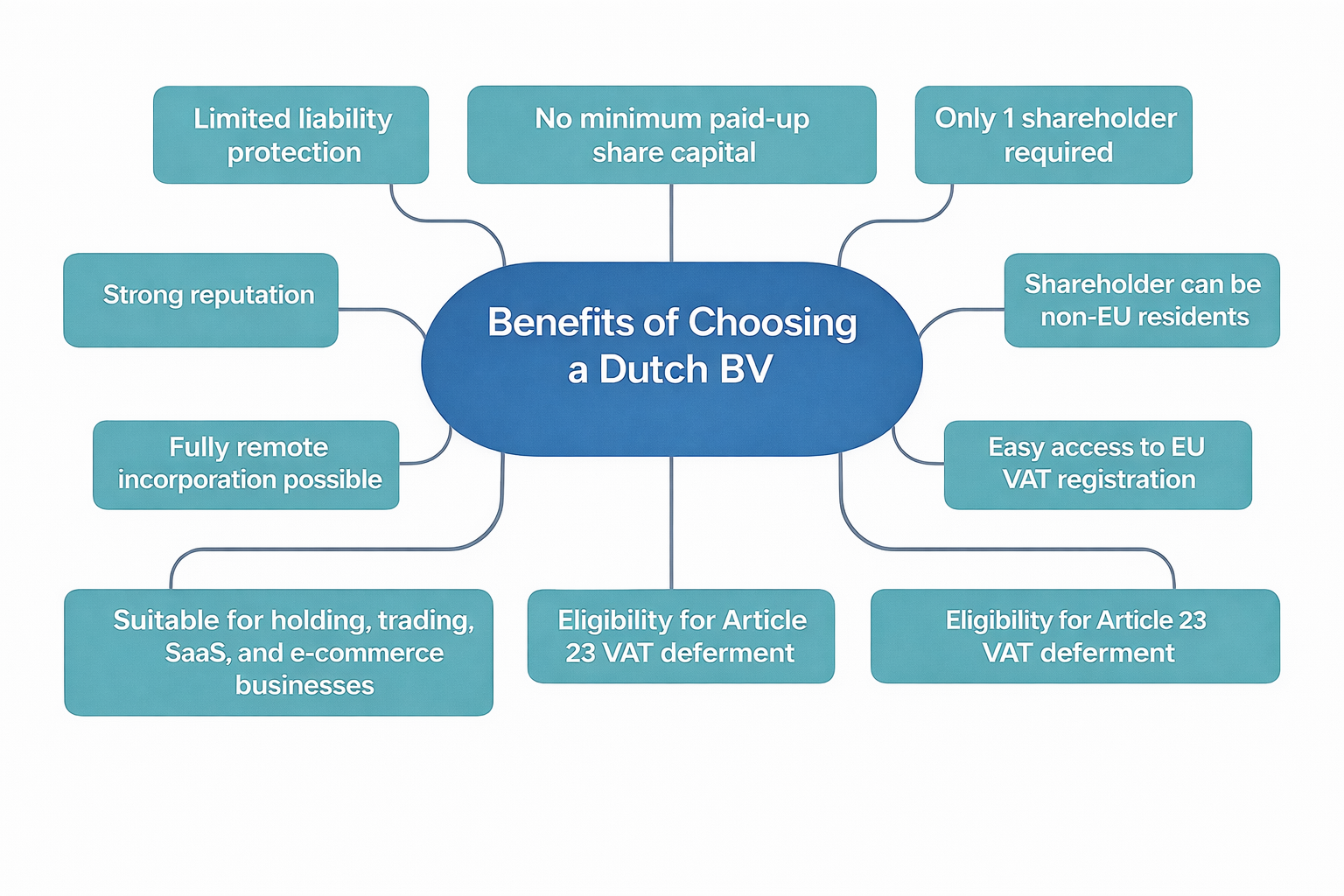
- Limited liability protection
- No minimum paid-up share capital
- Only 1 shareholder and 1 director required
- Shareholder and director can be non-EU residents
- Fully remote incorporation possible
- Strong reputation with EU banks and payment providers
- Easy access to EU VAT registration
- Eligibility for Article 23 VAT deferment
- Suitable for holding, trading, SaaS, and e-commerce businesses
For foreign founders, this structure reduces risk while increasing credibility. With this, they can start selling, invoicing, and contracting in the EU without setting up complex local arrangements in multiple countries.
What Documents Do Foreign Entrepreneurs Need to Set Up a Dutch BV?
As a foreign entrepreneur, you need to have these documents before a Dutch notary can prepare the incorporation deed. Here’s what we typically collect from founders:
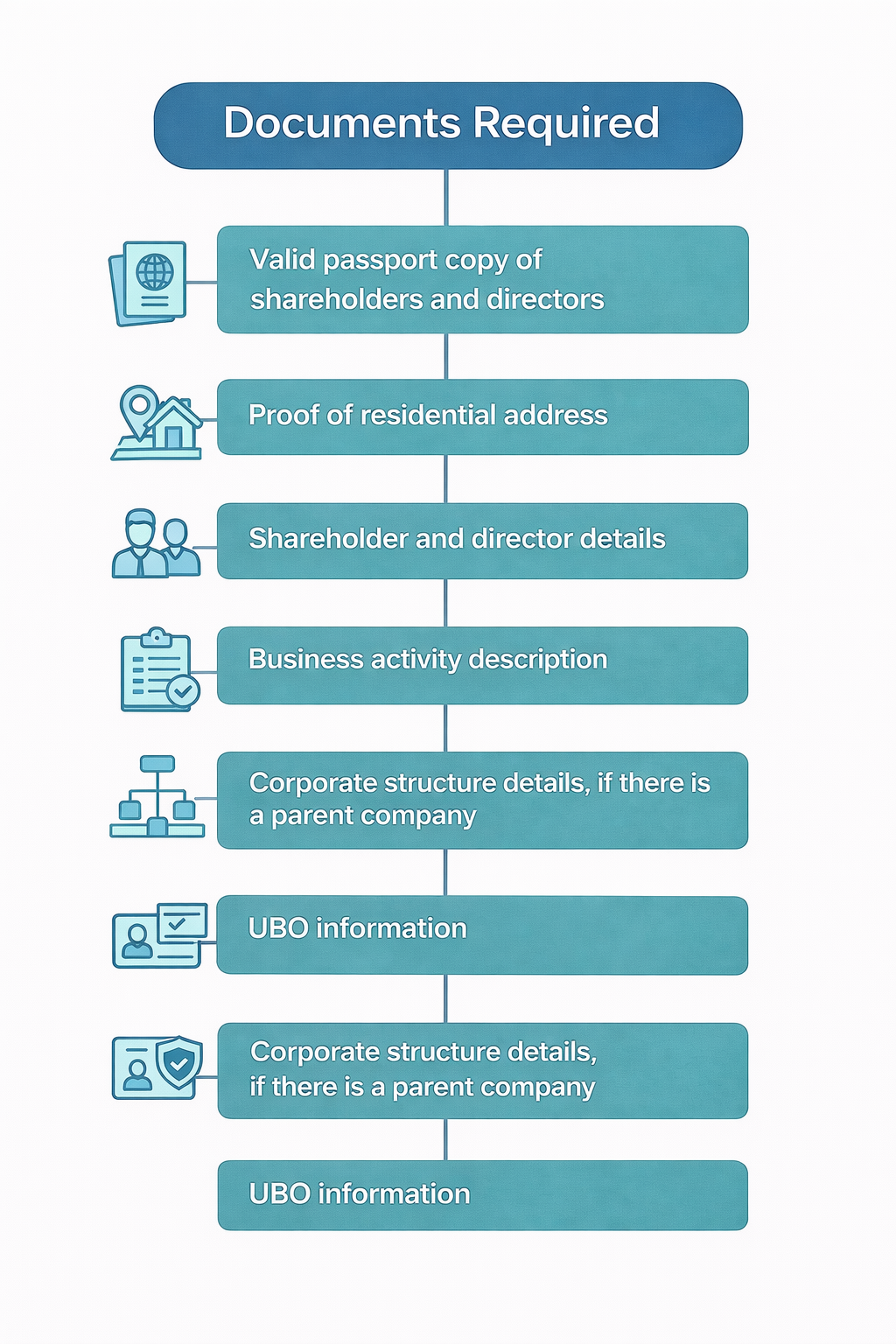
Here’s what we typically collect from founders:
- Valid passport copy of shareholders and directors
- Proof of residential address (utility bill or bank statement)
- Shareholder and director details
- Business activity description (we help align this with Dutch standards)
- Corporate structure details, if there is a parent company
- UBO information (ultimate beneficial owner)
Once these documents are reviewed, the process stays fully remote. The notary arranges an online video call for identity verification and signing. There is no need to visit the Netherlands in person.
These requirements are part of the wider Netherlands company registration process, which applies to all legal entities registered with the Dutch Chamber of Commerce.
We pre-check everything before it reaches the notary to avoid back-and-forth questions and ensure the deed is drafted correctly the first time. This step alone saves founders several days, sometimes even weeks.
Process Overview: How We Incorporate Your Dutch BV?
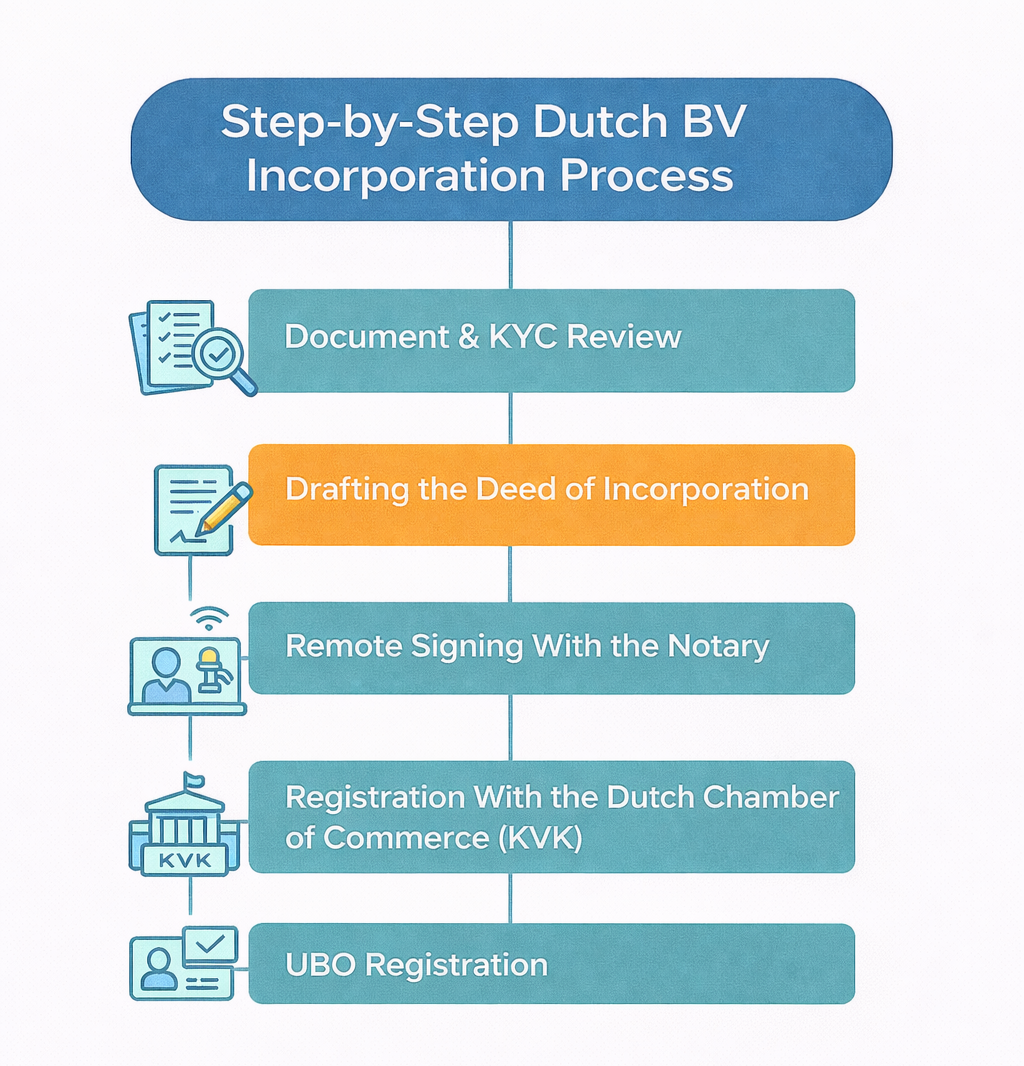
Once you have all the required documents mentioned above, the actual incorporation of a Dutch BV follows a clear legal flow. We manage this process end to end, so founders don’t have to coordinate with multiple parties or guess what comes next.
Step 1: Document & KYC Review
We first verify all shareholder, director, and UBO details. This includes identity checks and structure validation. This step is important because Dutch notaries follow strict compliance rules, especially for foreign founders.
Step 2: Drafting the Deed of Incorporation
After verification, the Dutch notary prepares the BV’s deed of incorporation. This document is drafted in Dutch, as required by law. We review the draft with you and explain everything in simple terms before signing.
Step 3: Remote Signing With the Notary
The signing happens through an online video call. You sign digitally, and there is no need to travel to the Netherlands. We coordinate the entire call and make sure it goes smoothly.
Step 4: Registration With the Dutch Chamber of Commerce (KVK)
Once signed, the notary files the deed with the Dutch Chamber of Commerce. Your company is officially registered, and the KVK number is issued.
Step 5: UBO Registration
Shareholders and directors are registered in the UBO register, which is mandatory under Dutch law. We handle this as part of the incorporation flow.
After this step, your Dutch BV legally exists and is ready for operational setup like VAT, banking, and accounting — which is where most founders need local guidance.
Post-Incorporation Compliance You Must Handle
After Dutch BV setup, the real responsibility starts, which involves VAT, banking, bookkeeping, and ongoing compliance obligations. Many founders think the job is done after getting the KVK number. However, in reality, this is where Dutch compliance becomes important. We see this confusion often, especially with foreign founders operating remotely.
The first priority is VAT registration. If you plan to invoice customers, sell online, or trade within the EU, a VAT number is mandatory. Along with this, many businesses also need an EORI number for importing or exporting goods. These registrations must be done correctly, otherwise payments and shipments can get blocked.
Next comes banking and bookkeeping. A Dutch BV is expected to maintain proper financial records, file VAT returns on time, and keep its administration in order. Dutch tax authorities monitor filings closely. Missed or incorrect filings can result in penalties or even temporary suspension of your VAT number.
This is exactly where having a local partner matters. At FirmNL, we help foreign entreprenuers to Incorporate a Dutch BV online and make sure VAT filings, bookkeeping, and compliance stay aligned with Dutch rules. This allows founders to focus on sales and growth instead of worrying about regulatory issues.
How FirmNL Simplifies Dutch BV Setup for Foreign Founders
Setting up a Dutch BV is not difficult, but doing it correctly without local knowledge can be risky. And that’s why FirmNL acts as your on-ground partner in the Netherlands for foreign founders and not just a service provider.
We coordinate directly with English-speaking Dutch notaries, handle all document checks, and manage communication with Dutch authorities. From BV incorporation to VAT, EORI, and Article 23 VAT deferment, everything stays under one roof. You don’t need to chase multiple advisors or translate legal language on your own.
Beyond registration, we support bank account setup, bookkeeping, accounting, and ongoing compliance. This is important because Dutch authorities expect consistency from day one. We make sure your company stays operational, compliant, and ready to scale in the EU.
We understand remote setups, cross-border structures, and EU expansion challenges. Our role is to remove uncertainty and delays, so your Dutch BV becomes a working business and not just a registered entity.
This is how we help founders enter the Dutch and EU market smoothly, with clarity and confidence.
Also Checkout: How To Apply For A Dutch VAT Number?
1. Can I set up a Dutch BV without visiting the Netherlands?
Yes. A Dutch BV can be incorporated fully remotely. The notary verification and signing happen through an online video call. At FirmNL, we manage the entire process so you don’t need to travel or appoint someone locally just to get started.
2. Do I need to be an EU or Dutch resident to open a Dutch BV?
No. Shareholders and directors can live outside the Netherlands and even outside the EU. We regularly work with founders from the US, UK, Asia, and the Middle East who successfully operate Dutch BVs from abroad.
3. Is VAT registration mandatory after setting up a Dutch BV?
In most cases, yes. If your business invoices clients, sells products, or operates in the EU, VAT registration is required. We handle VAT, EORI, and Article 23 registration together to avoid delays or compliance issues.
4. Why should I use FirmNL instead of doing it myself?
The legal setup is only one part of the process. Ongoing compliance, VAT filings, banking, and Dutch tax rules matter just as much. FirmNL acts as your local partner in the Netherlands, making sure everything works correctly from day one and stays compliant as you grow.



Ready to Launch
Your

Dutch Business
Dutch
Business
FirmNL specializes in helping foreign entrepreneurs establish a presence across the EU. From Dutch BV incorporation to tax compliance, sales outsourcing and EU fulfillment — we provide solutions tailored to your goals.