How Does Payroll Work For Remote Teams In The Netherlands?
4 Min
September 14, 2026
Author:
Garry

Expanding your business into the Netherlands gives you direct access to the European Union Market. However, managing payroll for remote teams in the Netherlands means following specific local labor laws, strict tax rules, and mandatory employee benefits.
Whether you are hiring your first remote employee in Amsterdam or scaling a workforce across Europe, understanding how to hire employees in the Netherlands and setting up compliant remote employee payroll is essential to avoid fines from the Dutch Tax and Customs Administration (Belastingdienst).
This guide breaks down how Dutch payroll for international employees works, compares your hiring options, explains mandatory rules, and gives you a step-by-step setup plan.
3 Ways to Run Netherlands Payroll for Remote Workers
Foreign companies cannot simply send an international bank transfer to pay a Dutch remote worker. To stay legal, you must choose one of three legal setups.
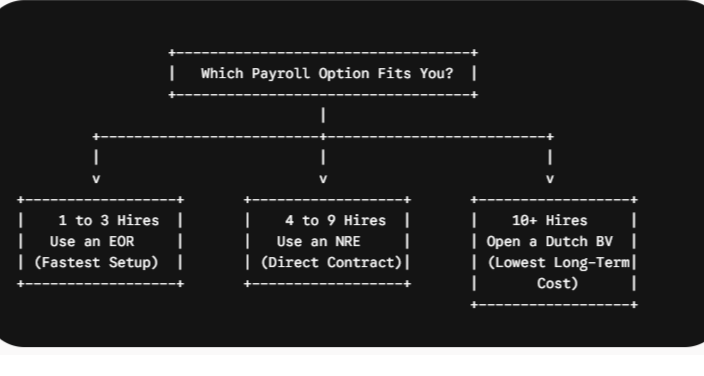
Employer of Record (EOR)
An EOR is a third-party service that legally hires the worker on your behalf in the Netherlands.
- How It Works: The EOR deals with all local contracts, payroll, taxes, and sick leaves compliance. You will keep control over the duties of your employee.
- Best For: Quick hiring of 1-3 remote workers without setting up an office in the country.
- Key Benefit: Quick start and minimal legal risks.
Non-Resident Employer (NRE) Registration
With an NRE setup, your foreign company remains the direct employer on the contract, but you register directly with the Dutch Tax Authorities.
- How It Works: Apply for a Payroll Tax Number (Loonheffingennummer) without incorporating a local entity. Engage a local Dutch payroll company to issue monthly salaries and pay taxes.
- Best For: Medium-sized teams interested in a direct employment agreement without setting up a local entity.
- Primary Benefit: Direct management of employment agreements with medium cost implications.
Local Business Entity (Dutch BV Incorporation)
Integrating a local company- usually a Dutch private limited company(Besloten Vennootschap or BV)—gives you a permanent corporate presence.
- How it works: Your Dutch BV company acts as a local subsidiary that employs your staff members.
- Suitable for: Larger teams of at least ten people and longer-term expansions, as well as businesses that are actively operating in Europe.
- Key benefits: Lower long-term costs per person, full control of benefit programs, and increased credibility in Europe.
Comparison of Dutch Payroll Setups
Core Statutory Rules for Dutch Payroll Compliance
To run compliant payroll for remote teams in the Netherlands, foreign employers must follow strict statutory regulations covering wages, tax withholdings, and mandatory allowances. Businesses without an internal payroll team can also consider payroll services in the Netherlands.
- Statutory Minimum Wage
Minimum wages are set by law throughout the country of the Netherlands. According to the legislation established in mid-2026, the minimum hourly wage payable to adults aged 21 years and above is €14.99 gross per hour. Companies should ensure that salaries offered to workers telecommuting are not below the hourly minimum set out in the legislation.
- Mandatory Holiday Allowance (Vakantiegeld)
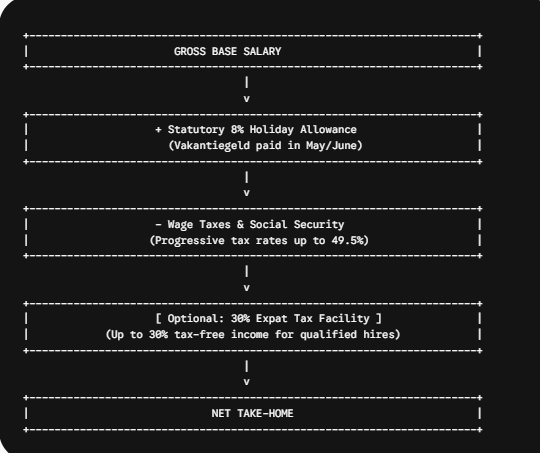
Dutch labor law requires employers to pay an annual holiday allowance of at least 8% of the employee's gross annual salary.
- Terms of Payment: This benefit accrues every month and is normally paid as a lump sum in either May or June.
- Contract Requirement: The 8 percent holiday pay has to be clearly stated in the terms of the employment contract. It cannot be covertly included in the base salary.
- Income Tax & Social Security Deductions
Wage taxes (loonbelasting) and social security (volksverzekeringen) in the Netherlands have progressive bracket structures. As one earns more, the tax rates become progressively higher, going as high as 49.5% for those earning more than others. It is an obligation for employers to withhold these taxes every month.
- The 30% Tax Ruling for International Hires
The 30% Ruling (30%-regeling) is a tax incentive designed to attract highly skilled international talent to the Netherlands.
- The benefit: It enables employers to give qualifying expat hires up to 30% of their gross salary tax-free to cover living and relocation costs.
- 2026 Salary Requirements: To qualify, the employee must have specialized skills that are scarce in the Dutch labor market. For 2026, the employee’s gross annual taxable salary must meet minimum thresholds:
General Employees (Age 30+): Minimum gross annual threshold of €48,013.
Young Professionals (Under 30 with a Master’s degree): Reduced threshold of €36,497.
- Requirement of Employer: The employer has to be registered as a withholding agent from the Netherlands to apply for this tax concession on behalf of their employees.
Step-by-Step: Setting Up Remote Employee Payroll in the Netherlands
Executing accurate Dutch payroll for international employees involves five steps:
Step 1: Pick Your Legal Structure
Consider which of these would suit your organization better in terms of staffing numbers and future expansion budgets: an EOR arrangement, a Non-Resident Employer registration, or a Dutch BV. In the event you establish a local entity, complete the incorporation process with the Dutch Chamber of Commerce (KvK).
Step 2: Obtain Withholding Agent Registration
Register as a withholding agent at the Belastingdienst if you hire employees through a Non-Residen.t
Employer or through a Dutch BV.
Step 3: Prepare Employee Contracts that Comply with Dutch Law
Prepare employee contracts that comply with tutch law. The contracts should be drafted as follows:
- Base salary rate and hours of work per week.
- The statutory element of 8% Vakantiegeld must be included.
- Statutory paid leave requirements (at least 20 days per year for a full-time 40-hour schedule).
- tory sickness payments (Dutch law mandates payment of 70% of salaries for 104 weeks during sickness).
Step 4: Claiming Expat Tax Benefits and Social Security
Apply for the 30% Ruling within four months from the commencement of work for eligible expatriates. Register your staff members for mandatory social security in the Netherlands.
Step 5: Processing Monthly Payroll & Submitting Tax Payments
Calculate gross-to-net pay per month, prepare compliant Dutch payslips (loonstroken), make payments of net salary, and submit monthly payroll tax filings to Belastingdienst. Businesses can also review how payroll processing in the Netherlands works in practice.
Common Pitfalls When Managing Remote Dutch Payroll
- Misclassification of Remote Freelancers: Classifying remote contractors as self-employed in the Netherlands can bring you into legal trouble. The Dutch law on assessment of employment relationships has strict penalties in place for false self-employment, including retroactive tax bills and unpaid social premiums along with interest charges.
- Ignoring Collective Labor Agreements (CAOs): There are various industries in the Netherlands that are mandated by Collective Labor Agreements (Collectieve Arbeidsovereenkomst). The CAOs lay down very strict and industry-specific regulations for minimum wages, overtime payment, and obligatory pension schemes overriding all basic labor regulations.
- Missing Expat Filing Windows: Submitting the 30% Ruling application after the strict 4-month window means losing retroactive tax savings for your employees.
How FirmNL Simplifies Dutch Payroll & Market Entry
Expanding into the Dutch market doesn’t have to be complicated. FirmNL provides clear, end-to-end support for international businesses building remote teams in the Netherlands and the European Union.
From dealing Dutch BV incorporation and Non-resident employer registrations to running turnkey payroll administration, VAT registration, and corporate tax advisory, FirmNL takes care of local regulations so you can focus on growing your business.
Ready to launch your remote team in the Netherlands? Contact the market-entry specialists at FirmNL today to find the right payroll solution for your international workforce.
Conclusion
Managing remote employee payroll Netherlands comes down to selecting the right legal framework for your growth stage. Small teams testing the market can launch faster using an Employer of Record (EOR), mid-sized teams benefit from direct contracts via Non-resident Employer (NRE) registration, and growing businesses with 10 or more hires lower long-term expenses through a local Dutch BV incorporation.
Whichever path you take, staying complaint requires strict adherence to local rules- from mandatory 8% holidayq allowances (Vakantiegeld) to the minimum wage requirements and the 30% Ruling for foreign employees among others. Engaging in collaboration with the locals is assured to keep your remote workers compliant.
Frequently Asked Questions
Is it possible for a foreign firm to employ a remote worker from the Netherlands without establishing an entity there?
Yes, it is legal for foreign companies to hire remote Dutch workers without setting up a local legal entity through an Employer of Record (EOR) service or registration as a Non-Resident Employer (NRE) with the Dutch Tax Authority (Belastingdienst).
What is the statutory minimum wage in the Netherlands?
The standard statutory minimum wage in the Netherlands is €14.99 gross per hour for adults who are 21 years of age or older.
What is the holiday allowance required under Dutch labor law?
According to the laws of the Netherlands, the mandatory annual holiday allowance (Vakantiegeld) should be 8% of the gross annual salary of an employee, paid in May or June each year.
Does the 30% Tax Ruling apply to remote international hires in the Netherlands?
Under the 30% Tax Ruling, the employees eligible to work remotely in the Netherlands may obtain exemption from taxes in the amount of up to 30% of their gross salaries.
What are the risks of misclassifying a remote worker as an independent contractor?
An incorrect categorization of a full-time employee as an independent contractor (freelancer or ZZP'er) is a breach of the Dutch Wet DBA legislation. The tax agency aggressively issues retroactive tax assessments, including back payroll taxes, social security payments, interest, and heavy fines.
Is it required that foreign employers observe CAOs in the Netherlands?
Yes. When your business field is regulated by the mandatory CAO agreement, it means that regardless of your company's headquarter's location, you are obliged to follow CAO-regulated salary rates, work schedule, and pension requirements.
How long does it take to register as a Non-Resident Employer in the Netherlands?
To receive the payroll tax registration number in the Netherlands (loonheffingennummer) as a foreign non-resident employer usually takes 2 to 4 weeks.



Ready to Launch
Your

Dutch Business
Dutch
Business
FirmNL specializes in helping foreign entrepreneurs establish a presence across the EU. From Dutch BV incorporation to tax compliance, sales outsourcing and EU fulfillment — we provide solutions tailored to your goals.